Colorado's Alien Watchtower: The UFO Site Hiding in Plain Sight
A Colorado watchtower built for spotting UFOs sits quietly off the highway. Here's the strange, real history behind it and its place in the state's UFO lore.
A Tower Built to Watch the Sky
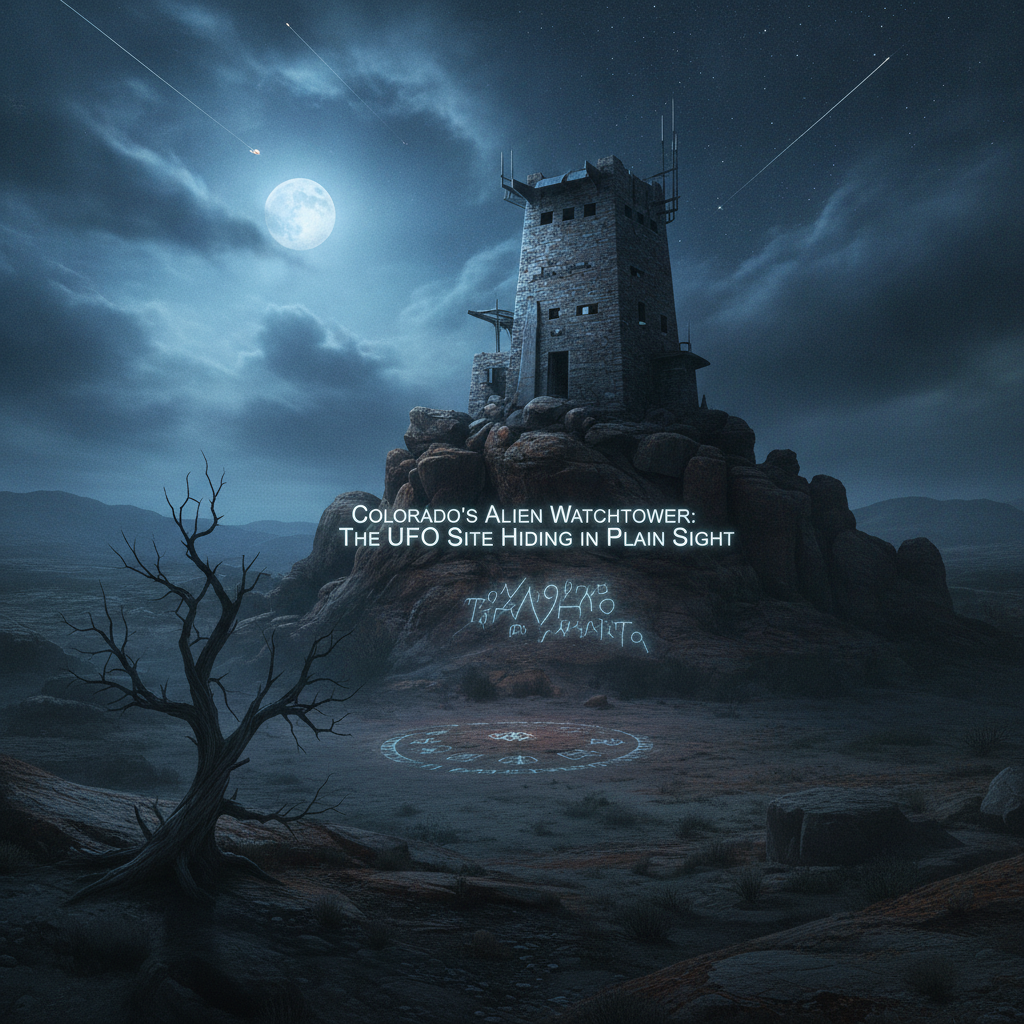
Drive south on Highway 17 through the San Luis Valley, past the potato fields and the wind-scoured sagebrush flats between Alamosa and Hooper, and you’ll see it rising out of the emptiness like something out of a fever dream: a squat, dome-topped tower ringed by a garden of odd metal sculptures, its gravel lot dotted with visitors squinting up at a sky that, in this part of Colorado, has a reputation for showing them things.
This is the UFO Watchtower, and it has spent more than two decades doing exactly what its name promises — giving people a place to stand, look up, and wait.
As Fast Food Club noted in a recent feature on the roadside attraction, the Watchtower isn’t a hoax dressed up for tourists or a kitschy gas-station gimmick. It’s a genuine, if eccentric, piece of Colorado UFO lore — a small business built entirely around the idea that the San Luis Valley is one of the strangest patches of sky in North America, and that people deserve a place to watch it properly.
The Valley That Started It All
To understand why anyone would build a UFO-watching platform in the middle of nowhere, you have to understand the San Luis Valley itself. Ringed by the Sangre de Cristo and San Juan mountains, sitting at roughly 7,500 feet, the valley has been a magnet for strange reports for decades — long before the Watchtower ever went up.
The most infamous chapter is the cattle mutilation panic that swept the region starting in the 1960s and 70s, when ranchers began finding livestock with organs removed and blood drained through wounds locals described as unnaturally clean. The case of “Snippy” the horse, found dead near Alamosa in 1967 under circumstances that generated national headlines, is still cited as one of the opening events in America’s modern mutilation mythology. Theories ranged from predators to secret military testing to, inevitably, extraterrestrial involvement — and none of them were ever definitively proven.
Layered on top of that is decades of raw sighting data. The National UFO Reporting Center (NUFORC), the archive most serious UFO researchers point to when they want documentation rather than folklore, has logged sightings from the San Luis Valley region for years — lights that move against the wind, silent craft that hover and vanish, formations that don’t match aircraft, weather balloons, or known flight paths. None of it is proof of anything otherworldly. But the sheer volume of reports from this one valley, compared to the surrounding high desert, is part of what gave the region its reputation long before cable television ever showed up with cameras.
Judy Messoline and the Business of Watching the Sky
The Watchtower itself was founded by Judy Messoline, a former rancher who, according to widely reported accounts of the attraction’s history, bought land in the valley in the late 1990s with plans to raise cattle — only to find the land unsuitable for that purpose. Rather than abandon the property, she leaned into the valley’s already-established strange reputation and opened the UFO Watchtower in 2000 as a small roadside business: an observation platform, a gift shop, a campground, and an open invitation for visitors to report and discuss their own sightings.
What makes the Watchtower more than a novelty stop is its guestbook-style culture of documentation. Over the years, visitors have filled notebooks with their own accounts of lights, shapes, and unexplained aerial phenomena witnessed from the platform — an informal, unscientific but strangely earnest archive of a community’s ongoing relationship with its own sky. It’s not NUFORC. It’s not a government file. But it’s real, and it’s been quietly accumulating for a quarter century.
A Convenient Moment for a Watchtower
The Watchtower’s continued pull on visitors this year lands in the middle of an unusually active stretch of UFO news out of Colorado and Washington alike.
The Denver Gazette recently reported that the CIA’s own website features a case file describing a “frightening” UFO sighting that occurred in Colorado — a rare instance of the intelligence agency’s public reading room surfacing a Colorado-specific case rather than the more commonly cited incidents from other states. The CIA has maintained a public archive of declassified UFO-related documents for years, largely tied to Project Blue Book-era investigations and Cold War-era sighting reports, and the resurfacing of a Colorado case adds another thread to the state’s long, tangled relationship with unexplained aerial phenomena.
Meanwhile, the Colorado Springs Gazette reported this week that the Colorado director of the Mutual UFO Network (MUFON) expressed sharp disappointment with the Department of Defense’s latest release of UAP-related files, arguing the disclosure fell short of what serious researchers and the public were expecting. MUFON has functioned for decades as one of the most prominent civilian organizations collecting and investigating UFO reports across the country, and its Colorado chapter has a direct interest in exactly the kind of sighting data the San Luis Valley has generated for years. The director’s criticism reflects a broader frustration among UAP researchers who have watched the federal government’s disclosure efforts unfold in fits and starts, often raising more questions than they answer.
And then there’s Congresswoman Lauren Boebert, whose western Colorado district sits not far from the valley’s own UFO corridor. The Colorado Times Recorder recently reported on Boebert’s public comments weighing in on UAPs, in which she referenced the biblical Nephilim alongside more conventional extraterrestrial explanations — a striking example of how thoroughly the UAP conversation has moved beyond fringe forums and into the mouths of sitting members of Congress. Whatever one makes of the comparison, it underscores just how mainstream — and how strange — the disclosure conversation has become.
What the Watchtower Really Offers
None of this news confirms anything about what people have actually seen from that gravel lot off Highway 17. The Watchtower doesn’t claim to have proof, and it shouldn’t be mistaken for one. What it offers is something rarer than proof: a place built, sincerely, for looking.
In an era of declassified files, congressional hearings, and government disclosure debates that often generate more frustration than answers, there’s something almost old-fashioned about a rancher-turned-entrepreneur setting up a platform in the desert and telling people, simply, to watch the sky themselves. The San Luis Valley has been generating strange stories for far longer than the Pentagon has been generating press releases about them. The Watchtower didn’t create that mystery — it just gave it a place to stand.