
Judy Messoline's Watchtower: 25 Years Watching San Luis Valley Sky
How a retired rancher built a roadside UFO watchtower in the San Luis Valley — and why decades of sightings keep visitors watching the sky.
A Roadside Attraction Built on Faith in the Unknown
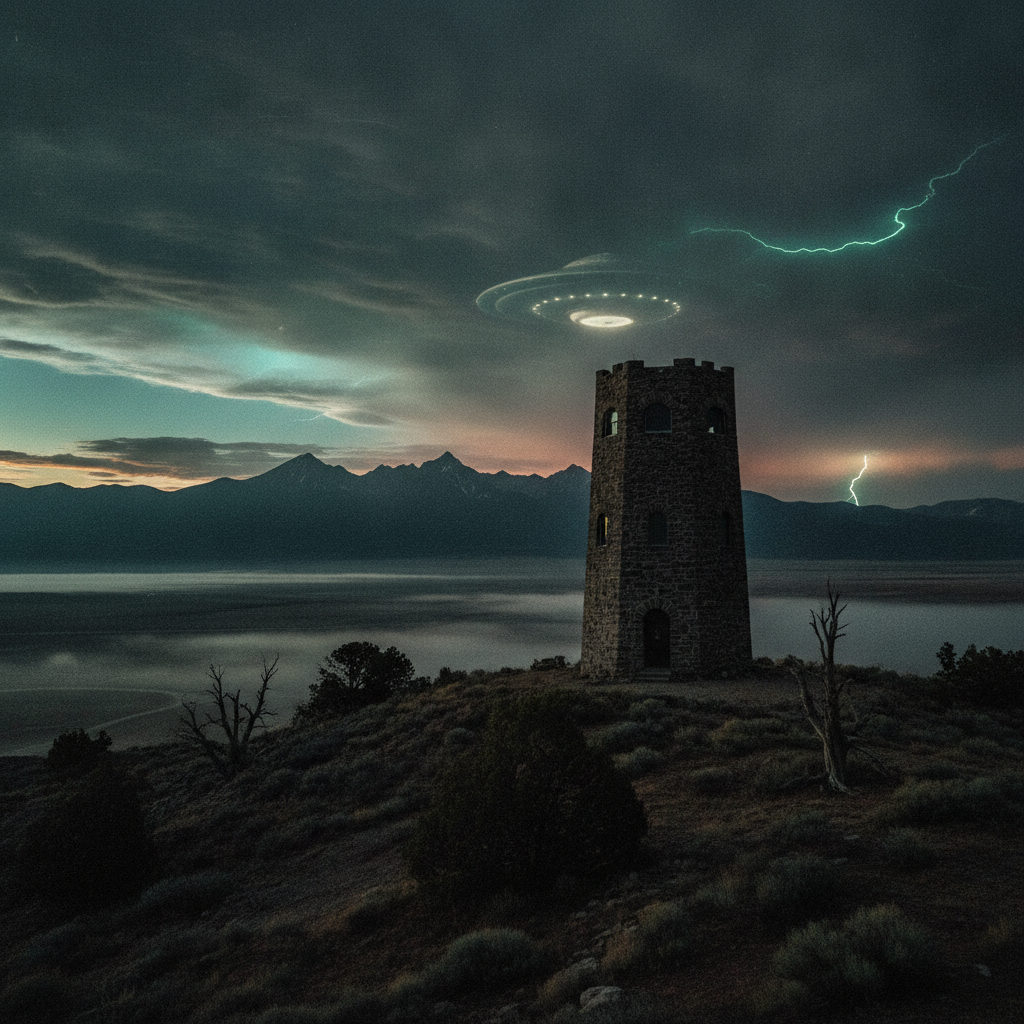
Off a lonely stretch of Highway 17 near Hooper, Colorado, where the San Luis Valley stretches flat and empty toward the San Juan Mountains, a strange metal structure rises out of the sagebrush. It’s not much to look at — a modest observation deck, a gift shop, a healing garden ringed with folk art — but for twenty-five years, people have been driving hundreds of miles to sit on its platform after dark and wait for something to happen in the sky.
This is the UFO Watchtower, and according to recent features in the Washington Post and AOL.com, it’s still drawing pilgrims, skeptics, and the simply curious a quarter-century after a retired cattle rancher named Judy Messoline decided to build it on a whim.
From Ranchland to Roadside Legend
Messoline’s story, as recounted in the Washington Post’s coverage this week, is one of the stranger second acts in Colorado history. She wasn’t a UFO researcher or a believer looking to cash in on alien mythology — she was a rancher who, according to her own retelling over the years, struggled to make her land profitable for cattle and eventually gave up on ranching altogether. Rather than let the property sit fallow, she opened it to the public as a place to watch the sky, betting that the valley’s already-established reputation for strange lights would bring visitors.
That bet paid off. The Watchtower has become one of Colorado’s most beloved oddball attractions, a fixture of “weird Colorado” road trips alongside places like the Center for Wonder and the Bishop Castle further south. As the AOL.com feature on the site — part of its “We Are San Luis Valley” series — describes, it functions as both an actual observation platform and something closer to a shrine, with a “healing garden” full of visitor-made totems, crystals, and offerings left by people who say they’ve experienced something inexplicable in the valley.
A Valley With a Reputation Decades in the Making
The Watchtower didn’t create the San Luis Valley’s UFO lore — it capitalized on a reputation that had already been building for decades before Messoline ever broke ground. The valley, a high-altitude basin roughly the size of Connecticut, has one of the longest documented histories of unexplained aerial sightings and livestock deaths in the country.
The case that put the valley on the paranormal map nationally was the death of a horse named Snippy (also referred to as “Lady”) near Alamosa in September 1967. Snippy was found stripped of flesh above the neck, in a manner ranchers and investigators at the time couldn’t easily explain, and the case drew national press attention and speculation ranging from predator activity to radiation to extraterrestrial involvement. It’s widely considered one of the first cattle mutilation cases to receive serious mainstream coverage, and it set the tone for decades of similar reports across the valley involving cattle found with organs or tissue removed with what witnesses described as surgical precision.
Throughout the 1970s, 80s, and 90s, ranchers across the valley continued to report unexplained animal deaths, and residents logged sightings of unusual lights moving in patterns they said didn’t match aircraft, weather balloons, or known astronomical phenomena. The valley’s remoteness, dark skies, and thin, high-altitude air have long been cited by researchers as contributing factors — both to the actual visibility of unusual phenomena and to the kind of atmospheric conditions that can produce optical illusions, temperature inversions, and other explanations for reported lights. Some ufologists, meanwhile, have proposed theories involving underground military activity or geomagnetic anomalies in the region — claims that remain speculative and unproven, but persistent in valley lore.
The Guestbook: A Quarter-Century of Testimony
Perhaps the most compelling artifact at the Watchtower isn’t the tower itself but its sighting logs and guestbooks, which Messoline has kept since the site opened. According to the Washington Post’s recent feature, these logs contain thousands of entries from visitors describing lights, orbs, and objects they say they witnessed while sitting on the platform after dark. It’s important to be clear about what these represent: they are visitor testimony, not verified scientific data. Nobody — not Messoline, not any government agency, not any research organization — has confirmed the nature of what’s being reported. But the sheer volume and consistency of the accounts, collected over twenty-five years, has made the Watchtower a genuine grassroots archive of a phenomenon that shows no sign of losing public fascination.
That fascination has only intensified in recent years amid a broader national reckoning with UFOs — now officially termed UAPs, or unidentified anomalous phenomena — following Pentagon disclosures and congressional hearings that began in earnest in 2017 and have continued in fits and starts since. The Washington Post’s framing of the Watchtower as a place “waiting for the government to catch up” captures something real about the current moment: official Washington is now, however cautiously, using language that roadside attractions in Hooper, Colorado, have been using unofficially for decades.
It’s worth noting that this heightened national interest has also produced no shortage of speculative claims that go well beyond anything documented at the Watchtower — from theories linking Utah’s Skinwalker Ranch to sites like Sedona via alleged underground tunnels, to claims connecting declassified Pentagon footage to ancient Egyptian monuments. These remain firmly in the realm of speculation and should be treated as such; they have no established connection to the San Luis Valley or its documented history.
Why the Valley Still Matters
What makes the UFO Watchtower genuinely compelling isn’t proof of anything extraterrestrial — it’s the fact that it exists at all, built by an ordinary Colorado rancher who turned uncertainty into a livelihood and, in the process, gave the public a place to participate in one of the state’s oldest unsolved mysteries. Whether the lights people report over the San Luis Valley are aircraft, atmospheric phenomena, military testing, or something genuinely unexplained remains an open question — one that neither the Pentagon’s recent disclosures nor twenty-five years of guestbook entries have definitively answered.
For now, the tower still stands off Highway 17, the gift shop still sells alien-themed T-shirts, and visitors still climb the platform steps after sunset, scanning the vast Colorado dark for something they can’t quite name. In a state full of strange history — ghost towns, mining disasters, high-altitude oddities — the Watchtower endures as something rarer: a monument built not to a settled fact, but to an enduring question.