
The Denver Airport Rumor Mill: UFO Disclosure Hits Home Turf
As Congress pushes new UFO disclosure forums, Beyond the Rockies revisits why Denver International Airport became ground zero for America's conspiracy folklore.
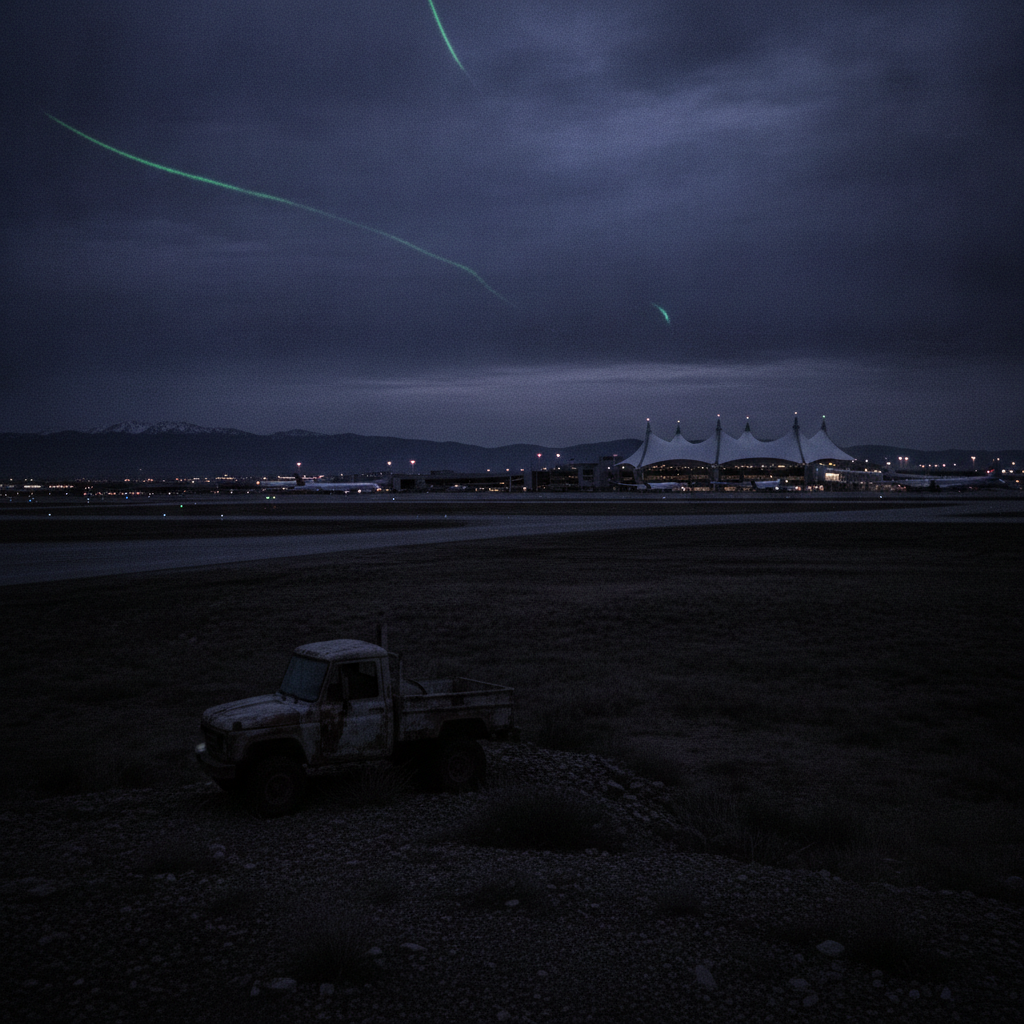
A Strange Week to Talk About Aliens
This has been an unusually earnest week for a topic that spent decades relegated to late-night radio and grainy VHS tapes. A bipartisan UFO disclosure forum in Washington has reportedly surfaced claims about a secret 1952 recording tied to the so-called “Invasion of Washington” incident, along with allegations of a Pentagon contractor loophole allegedly used to shield “nonhuman biological specimens” from oversight, according to reporting from International Business Times UK. Newly surfaced UFO files reportedly describe spinning discs, glowing orbs, and — in one memorably odd entry — an object shaped like a potato, per Dunya News. Even the Air Force’s own history in this arena is getting fresh scrutiny: the Boulder Reporting Lab recently revisited the Air Force–funded UFO study once conducted at CU Boulder, examining what researchers actually found decades ago versus what the folklore later made of it.
It’s a legitimate news cycle, populated by actual congressional statements, actual documents, and actual research institutions. And yet, if you mention “UFOs” and “Colorado” in the same sentence to most people, their minds don’t drift toward Boulder’s Cold War-era research or Washington’s current hearings. They go straight to a mid-sized airport on the high plains northeast of Denver.
Denver International Airport has become, improbably, one of the most durable pieces of conspiracy folklore in modern America — a place where blue mustang statues supposedly kill their creators, painted murals supposedly warn of coming apocalypse, and a dedication stone supposedly marks the cornerstone of a New World Order. None of it has anything to do with actual UFO research. But the timing of this week’s disclosure conversations offers a good excuse to ask: why does DIA keep pulling focus from the real thing?
The Airport That Built Its Own Myth
DIA didn’t need help generating suspicion. It built its reputation on real, well-documented dysfunction.
The airport opened in February 1995, sixteen months behind schedule, after a construction process that became a national punchline. Its automated baggage system — meant to be a marvel of engineering — famously shredded luggage and jammed conveyor belts during testing, delaying the opening and costing the city dearly. By the time DIA finally opened, reporting at the time (including extensive coverage from the Rocky Mountain News and the Denver Post) pegged the total cost at roughly $4.8 billion, well above the original projections of around $1.7 billion. That kind of overrun, paired with a broken baggage system that made international news, is fertile ground for suspicion. When a public project goes that far over budget and that far behind schedule, people start asking what, exactly, they were building down there.
That question got a boost from geography and design choices that seemed engineered for myth-making. The terminal’s tented roofline, meant to evoke the Rocky Mountains or Native American teepees depending on who’s explaining it, struck many visitors as unsettling rather than majestic. And underneath it all sits a genuine, functional system of utility tunnels and an automated train connecting concourses — real infrastructure that, filtered through decades of internet rumor, became “proof” of secret underground levels, bunkers, and facilities tied to everything from the Illuminati to extraterrestrial detention.
The Murals, the Horse, and the Stone
Three pieces of public art did more to cement DIA’s reputation than any actual anomaly ever could.
The first is a series of murals by artist Leo Tanguma, installed in the original Great Hall, depicting environmental destruction, war, and children in gas masks alongside imagery of peace and unity. Tanguma has publicly described the work as a message about environmental stewardship and the consequences of violence — a fairly conventional public-art statement about hope emerging from destruction. Conspiracy theorists, however, have spent thirty years reading the murals as prophecy: warnings of a coming genocide, a New World Order takeover, or worse. Some of the more apocalyptic panels were eventually removed during renovations, which — predictably — only fed the rumor mill further.
Then there’s “Blucifer,” officially titled “Mustang” — Luis Jiménez’s 32-foot-tall fiberglass blue horse with glowing red eyes, installed near the airport entrance. The statue has an actual tragic history: Jiménez was killed in 2006 when a section of the sculpture fell on him during fabrication, a real and well-documented accident reported by Colorado news outlets at the time. That fact, combined with the statue’s genuinely menacing appearance, was enough for internet lore to transform an artist’s workshop accident into evidence of a cursed or demonic object.
Finally, there’s the capstone — a granite marker in the airport’s Great Hall bearing a Masonic symbol and the words “New World Airport Commission,” a group that, according to Denver officials cited in local reporting over the years, was a one-time organizing committee for the airport’s dedication ceremony and time capsule, not any kind of shadow government body. The phrase “New World” combined with a Masonic emblem was, for online conspiracy communities, simply too tempting a coincidence to leave alone.
Real Disclosure vs. Tongue-in-Cheek Mythology
Here’s the contrast worth sitting with: this week, actual members of Congress are reportedly discussing actual claims about recordings, specimens, and contractor loopholes — claims that, whatever their ultimate merit, are being aired through formal channels, with named officials and documented forums. Decades ago, the Air Force funded real research at a real Colorado university to formally investigate UFO reports, a project the Boulder Reporting Lab recently revisited in detail.
DIA’s mythology is a different animal entirely. It has no whistleblower, no contractor, no leaked memo — just a expensive, delayed, oddly decorated airport that happened to open during the golden age of pre-internet conspiracy culture and then thrived once message boards and YouTube gave the rumors a permanent home. Denver International Airport has, over the years, publicly and repeatedly denied that anything sinister lies beneath its runways, even as it has occasionally leaned into the joke — its official social media accounts have winked at the conspiracy theories rather than fighting them, recognizing, correctly, that the legend is now part of its brand.
Why the Legend Wins
Real disclosure is messy, incremental, and often disappointing — it comes in the form of congressional testimony, redacted documents, and researchers cautiously parsing what a “study” actually concluded versus what a headline implies. DIA’s mythology, by contrast, offers something tidier: a single physical location where you can stand under a demon horse, walk past an apocalyptic mural, and photograph a Masonic capstone, all in one baggage claim.
That’s not a knock on the real disclosure conversation happening in Washington this week — it deserves to be taken seriously, and outlets are right to keep digging into it. But it’s worth understanding why, for thirty years running, the internet’s imagination has kept landing on a Colorado airport instead. DIA isn’t a UFO story. It’s an urban legend born from real cost overruns, real public art, and a very human need to find a story stranger than the mundane truth of a badly managed construction project.