Blucifer, Gargoyles, and Now Alien Tech: DIA's Weirdest Year Yet
A fresh wave of Denver Airport conspiracy coverage and a new federal push on secret UFO tech collide—here's what's real, what's rumor, and what's next.
The Airport That Never Stopped Whispering
There’s a reason Denver International Airport keeps landing back in the news cycle three decades after it opened. This week, Travel + Leisure published yet another roundup of the airport’s most persistent conspiracy theories — a reliable summer tradition at this point, like wildfire smoke or afternoon thunderstorms over the Front Range. But this time the timing feels different. Just days before that piece ran, International Business Times UK reported that a Trump administration UFO advisory team has been quietly pressuring defense contractors to disclose so-called secret alien technology.
Put those two stories side by side and something interesting happens. DIA’s decades-old folklore about hidden agendas and buried secrets suddenly reads less like a punchline and more like a rough draft — a public rehearsal, decades early, for the disclosure conversation the country is now actually having.
So let’s revisit what’s real about Denver’s strangest public building, and what isn’t.
The Murals That Started It All
Nearly every DIA conspiracy theory traces back to the same source: two murals painted by artist Leo Tanguma in the mid-1990s for the airport’s original construction. Titled “In Peace and Harmony with Nature” and “The Children of the World Dream of Peace,” the murals are large, unsettling, and undeniably strange to encounter in a place designed for security lines and gate changes.
One panel depicts a militarized figure in a gas mask wielding a sword over a dove, children in gas masks, and a wall of caskets watched over by grieving mourners. Another shows children from various cultures laying down guns and cultural symbols in a coffin, above a scene of environmental destruction giving way to renewal. Tanguma has spoken publicly over the years about the murals’ intended meaning — a message about war, ecological destruction, and hope for global peace, drawn from his experience as a muralist working in the Chicano civil rights movement.
That documented artistic intent hasn’t stopped visitors from reading the murals as prophecy or coded warning. Since the airport’s 1995 opening, theories have circulated that the imagery predicts genocide, martial law, or a coming New World Order. There’s no historical evidence supporting those readings — but there’s also no denying the murals were, and remain, deeply unusual choices for an airport terminal. Denver’s own tourism arm has leaned into the mystery rather than fight it, which has arguably kept the legend alive longer than if officials had simply removed the art.
Blucifer: A Statue With a Real, Tragic History
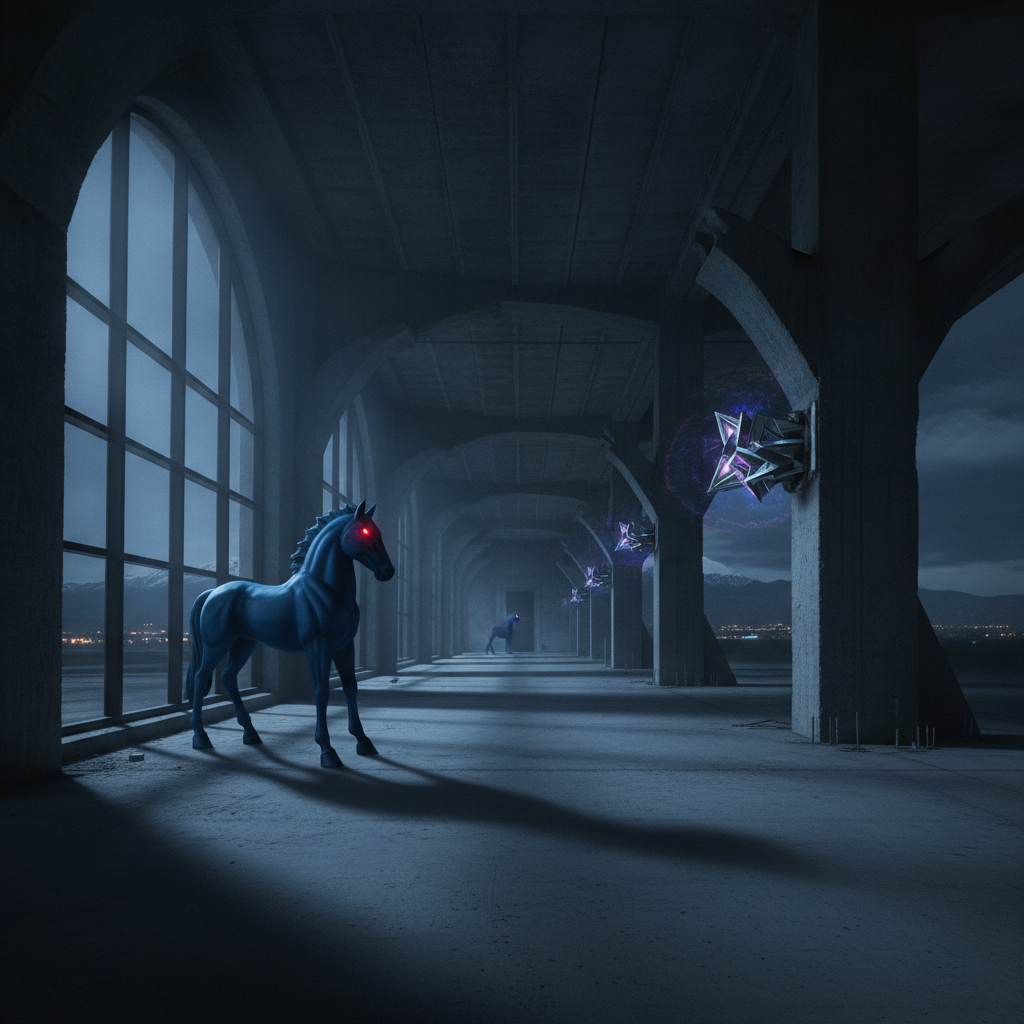
No DIA legend is more visually iconic than the 32-foot blue mustang with glowing red eyes that guards the airport’s entrance road — nicknamed “Blucifer” by locals and, eventually, nearly everyone else. Officially titled “Mustang,” the sculpture was the work of New Mexico artist Luis Jiménez.
The statue’s real backstory is grim enough without embellishment. In 2006, a piece of the sculpture fell during fabrication in Jiménez’s studio and severed an artery in his leg, killing him. His unfinished work was completed by his family and installed at DIA in 2008, two years after his death. That fact alone — a public artwork tied to its own creator’s death — has fueled years of speculation about curses, satanic symbolism, and hidden meaning behind the horse’s demonic-red eyes. Jiménez’s family and colleagues have described the piece as a tribute to the American Southwest’s mustang imagery, consistent with the artist’s decades of work depicting fiberglass animals in vivid color. The tragedy is documented fact. The curse is folklore built on top of it.
The Capstone, the Masons, and the New World Order
Then there’s the granite capstone dedicating the airport, embedded near the terminal with a time capsule buried beneath it. The marker bears the symbol of the Colorado Masonic organizations that sponsored the capstone ceremony, along with the phrase “New World Airport Commission” — a group that, according to Denver press coverage over the years, was a temporary host committee for the dedication event rather than any kind of shadow government body.
That hasn’t stopped the capstone from becoming Exhibit A for New World Order theorists, who point to the Masonic square-and-compass symbol and the ambiguous name as evidence of something more sinister buried beneath Denver’s high plains. Airport officials have addressed the confusion publicly, noting the mundane bureaucratic origin of the naming — but as with the murals, the explanation rarely travels as far as the legend.
Old Folklore, New Disclosure
Here’s where DIA’s forty-year-old mythology suddenly feels current again. The International Business Times UK report on a Trump administration UFO advisory team pressuring defense contractors toward disclosure of secret technology is part of a broader, ongoing federal conversation about unidentified aerial phenomena that has been building since Congressional hearings began putting the subject on the record in recent years. Whether or not that pressure produces meaningful new revelations remains to be seen — the report describes a push, not a confirmed disclosure.
But the symbolism is hard to ignore. Denver’s airport has spent three decades as a kind of pop-culture Rorschach test for distrust of institutions — a place where ordinary bureaucratic decisions (a mural commission, an artist’s tragic accident, a dedication ceremony) get reinterpreted as evidence of concealed truth. Now the federal government itself is wrestling publicly with exactly that dynamic: how much of what defense contractors know about unexplained technology should stay classified, and what obligation, if any, exists to disclose it.
DIA didn’t predict UFOs. But its enduring legend runs on the same fuel now driving the disclosure debate in Washington — the suspicion that official explanations are incomplete, and that somewhere beneath the official story, something else is buried.
What’s Actually Buried at DIA
For the record: there is a real time capsule under that capstone, scheduled for a future opening, its contents unpublicized. There are real utility tunnels beneath the airport, used for baggage and infrastructure systems, standard for a facility of DIA’s scale. And there are real, well-documented reasons behind the murals, the statue, and the dedication stone — reasons rooted in art, tragedy, and civic ceremony rather than conspiracy.
None of that has stopped the legend, and if this week’s news cycle is any indication, it isn’t going to. As the country’s UFO disclosure conversation heats up, Denver’s airport remains what it’s always been: not necessarily a portal to hidden truth, but a mirror reflecting how badly we want one to exist.