
When Defense Contractors Meet Colorado's UFO Skies
A new federal push for defense firms to disclose secret aircraft tech collides with Colorado's decades-old UFO hotspots. What could disclosure actually reveal?
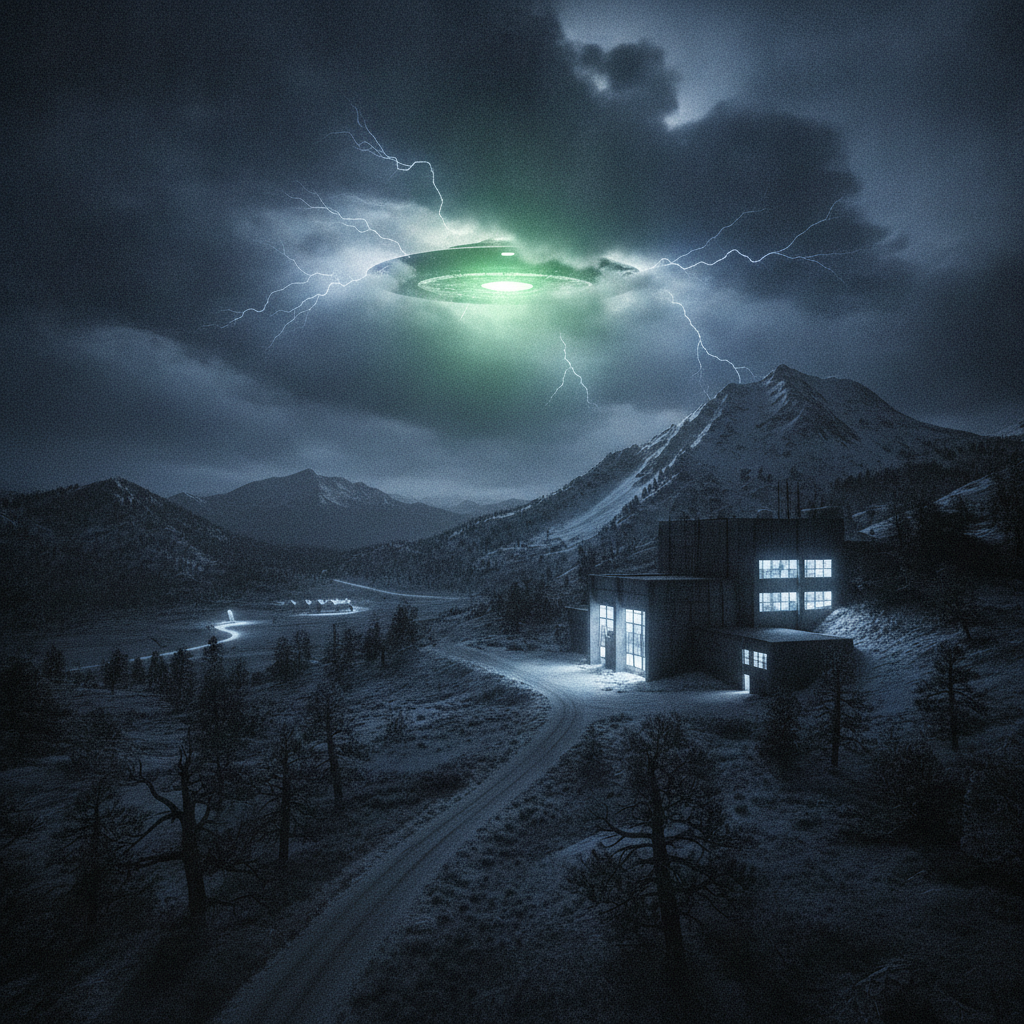
A Skeleton Key for Colorado’s Skies?
For decades, people standing in their backyards along the Front Range have looked up and seen things they couldn’t explain — silent triangles, pulsing lights that hang motionless for an hour and then vanish, formations of craft that move in ways commercial aircraft simply don’t. Colorado has long ranked among the most UFO-sighting-dense states in the country, and this week’s Stacker roundup of Colorado cities with the highest concentration of reports is only the latest reminder that this isn’t a fringe curiosity here — it’s practically a regional pastime.
But a new development out of Washington could complicate the mystery in an unexpected way. According to a report from International Business Times UK, a Trump administration UFO advisory team has begun pressuring major defense contractors to disclose classified aerospace technology — programs some believe have been quietly misidentified as “alien” craft for years. If that pressure produces real disclosure, it wouldn’t just reshape a national conversation happening in congressional hearing rooms. It would land, with particular force, on Colorado.
Because Colorado isn’t just a place where people see strange things in the sky. It’s a place where a significant amount of the technology capable of causing those strange sightings is designed, tested, and flown.
A State Built for Secrets
Colorado’s relationship with military aerospace runs deep. Colorado Springs is home to U.S. Space Command, along with a dense cluster of Space Force and Air Force installations along the Front Range. Just north, the Denver metro area hosts a major Lockheed Martin campus in Jefferson County, where spacecraft and defense systems have been engineered for generations. Add in Buckley Space Force Base, the Air Force Academy, and the broader web of contractors and subcontractors that orbit these institutions, and you have a state with one of the highest concentrations of classified aerospace work in the country.
This is not speculation — it’s a matter of public record and regional economic identity. Colorado’s aerospace sector is one of its largest industries, and much of it is tied directly to defense and intelligence work that, by design, the public is never meant to fully see.
That’s the tension at the center of this story. You have a state that is simultaneously one of the best places in America to build something secret and fly it in restricted airspace, and one of the best-documented hotspots for people reporting things they can’t identify. Those two facts sitting side by side aren’t proof of anything specific — but they raise a question researchers and disclosure advocates have asked for years: how much of Colorado’s UFO history might actually be classified human engineering, hiding in plain sight?
The Disclosure Push and What It Actually Asks For
The push described in the IBT UK report isn’t about proving extraterrestrial visitation — it’s about something more grounded, and in some ways more provocative: asking defense firms to come clean about their own secret technology. The theory driving this effort is that a meaningful percentage of UFO — or as the government now prefers, UAP (Unidentified Anomalous Phenomena) — reports may trace back not to visitors from another world, but to experimental drones, classified propulsion systems, sensor testbeds, or stealth platforms that contractors have never publicly acknowledged.
This isn’t a new idea. Investigators and historians have long pointed to programs like the U-2 and SR-71 — both flown out of classified test sites and both linked, after the fact, to spikes in UFO reports during the Cold War — as evidence that some “unexplained” sightings eventually get explained, decades later, once the secrecy expires. The current advisory push, as reported, aims to accelerate that timeline by encouraging — or pressuring — contractors to disclose relevant programs now rather than in fifty years.
For Colorado, that raises a genuinely interesting possibility: if firms like Lockheed Martin, or others operating near Space Command’s sprawling network of installations, were to disclose classified test programs conducted over Colorado airspace in past decades, some portion of the state’s UFO archive could suddenly gain mundane, terrestrial explanations. Not all of it. Possibly not even most of it. But some.
What Disclosure Could — and Couldn’t — Explain
It’s worth being precise about what this kind of disclosure realistically offers. Even the most forthcoming contractor testimony would only account for sightings tied to specific programs, specific timeframes, and specific airspace corridors. It would not address the full breadth of Colorado’s UFO history — the ranch encounters, the cattle mutilation cases of the 1970s in the San Luis Valley, the multi-witness sightings reported far from any restricted military corridor.
Researchers who study the overlap between classified aerospace testing and UFO reports generally caution against collapsing the two categories into one explanation. The theory that “it’s probably just the military” is popular precisely because it’s plausible in a state like Colorado — but plausibility isn’t proof. Some sightings near Colorado Springs, given the density of Space Command and Air Force activity in the region, may well trace back to sensor platforms or experimental aircraft the public has never heard of. Others resist that explanation entirely, either because of their described flight characteristics, their location far from any known test corridor, or the credibility and consistency of multiple independent witnesses.
That distinction matters. Treating every unexplained light over the Rockies as “probably classified tech” is its own kind of unproven assumption — just a more comfortable one than the alternative.
Why Colorado Should Be Watching Closely
If this contractor disclosure push produces real results — actual acknowledgment of programs, actual timelines, actual airspace data — Colorado will be one of the most important places in the country to watch. It’s rare for a single state to sit at the intersection of two forces this significant: a robust defense-industrial base capable of generating genuinely mysterious aircraft, and a public deeply engaged in tracking and reporting what it sees overhead.
Whether meaningful disclosure actually happens remains an open question. Defense contractors have institutional, legal, and national-security incentives to keep classified programs classified, regardless of political pressure from an advisory team. History suggests that when disclosure does come, it arrives slowly, selectively, and usually only after the technology in question is thoroughly obsolete.
For now, the lights over the Front Range remain exactly what they’ve always been: unexplained. Some may one day be traced back to a hangar in Jefferson County or a test range tied to Space Command. Others may not be explained at all. That uncertainty isn’t a failure of investigation — it’s the actual, honest state of the evidence. And in a state as tangled up in both secrecy and sky-watching as Colorado, that uncertainty is likely to persist long after this particular disclosure push fades from the news cycle.