
Snippy the Horse: Colorado's First Cattle Mutilation Case
In 1967, a mutilated horse in the San Luis Valley sparked America's cattle mutilation phenomenon and decades of UFO speculation.
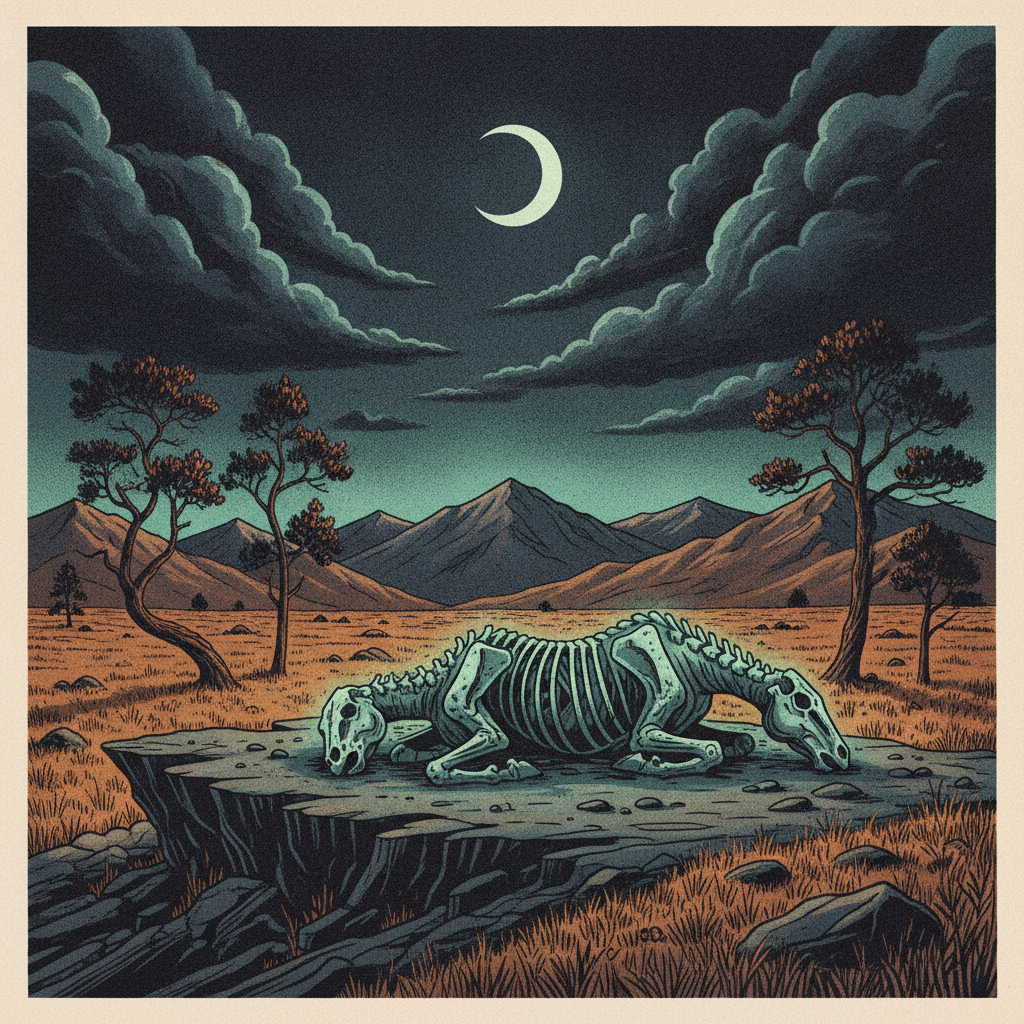
A Horse Named Lady, Found Dead in the San Luis Valley
Long before “cattle mutilation” became a phrase that could conjure images of black helicopters and cloaked government vans crisscrossing rural Colorado, there was simply a horse named Lady, found dead in a pasture near the small town of Hooper, in Colorado’s high-desert San Luis Valley. What happened to her in September 1967 — and what didn’t happen, which is arguably stranger — set off a phenomenon that has haunted ranchers, sheriffs, and UFO researchers across the American West for more than half a century.
Today, Lady is better known by the nickname the press gave her: Snippy. And her case is widely credited, by researchers and journalists alike, as the opening chapter of America’s cattle mutilation mystery.
The Discovery
According to contemporary newspaper accounts from 1967, Lady was found dead on a ranch in the valley, her head and neck stripped almost surgically clean of flesh, while the rest of her body was left largely untouched. There was reportedly no blood at the scene — an absence that would become one of the signature, unnerving hallmarks of mutilation cases that followed for decades across Colorado, Kansas, Nebraska, and beyond.
The local sheriff’s office, based in Saguache County, was called in to investigate. Period reporting described a scene that didn’t fit neatly into any obvious explanation: no tracks consistent with a predator attack, no obvious blood trail, and cuts on the animal that struck investigators and locals as unusually clean. Whether those cuts were truly “surgical” in the forensic sense, or simply appeared that way to ranchers and reporters unfamiliar with how scavengers and decomposition can alter a carcass, remains one of the central disputes of the case to this day.
A Story That Went National
What made Lady’s death different from the countless livestock deaths that happen on Colorado ranches every year wasn’t just the strange condition of the carcass — it was the timing and the setting. The San Luis Valley in the late 1960s already carried a reputation for unusual aerial sightings, and local newspapers covering the story connected the horse’s death to reports of unidentified lights and objects seen in the sky around the same period. That connection, made in print within days of the discovery, is what transformed a single dead animal into a story with national legs.
Wire services picked it up, and within weeks “Snippy the Horse” was known well outside Colorado. The case became a kind of Rorschach test: readers and investigators projected onto it whatever explanation felt most plausible to them, and in 1967, plausibility ranged wildly.
The Theories, Then and Now
Several explanations circulated in the immediate aftermath, and honest treatments of the case — then and now — have to weigh all of them rather than leaping to the most sensational.
Predators and scavengers. The most conventional explanation offered by some investigators was that natural predation and subsequent scavenging by birds, coyotes, or other animals could account for the missing flesh, and that decomposition in the dry valley air could explain the lack of visible blood. Critics of the UFO angle have long pointed out that carcasses left in the open for even a short time can take on an appearance that looks far more “surgical” to the untrained eye than it actually is.
Government testing. Because the San Luis Valley sits within reach of military and government installations elsewhere in the region, rumors circulated in 1967 that the horse might have been exposed to some kind of secret chemical or biological testing, or even nerve agent exposure — an idea that gained traction in an era when the public was increasingly aware of military experiments involving animals. No documented evidence has ever definitively tied Lady’s death to any specific government program, but the theory persisted precisely because so little was ever officially explained.
Ritual or human activity. Some at the time floated the idea of a deliberate, human-caused killing — whether as a prank, a act of cruelty, or something more ritualistic — though no suspect, motive, or physical evidence of human involvement was ever substantiated in the reporting from that period.
UFO involvement. Then, of course, there was the explanation that captured the public imagination and never let go: that Lady’s death was connected to the unidentified aerial phenomena reported around the valley in the same window of time. This theory was never proven, but it also was never definitively disproven, and it’s the one that has shaped the case’s legacy more than any other.
Researchers who have spent decades documenting the San Luis Valley’s paranormal reputation — most notably author Christopher O’Brien, who has written extensively about the region’s UFO and unexplained-phenomena history — have treated the Snippy case as a foundational, if frustratingly inconclusive, piece of the valley’s strange record. O’Brien’s work, built on archival research and interviews conducted long after the fact, has helped keep the case alive in the public record even as the physical evidence from 1967 has long since been lost to time.
The Case That Started It All
What’s most significant about Snippy isn’t necessarily what happened to her — it’s what happened afterward. In the years following her death, reports of similarly mutilated cattle began surfacing across Colorado and the broader American West, particularly through the 1970s. Ranchers from the San Luis Valley to eastern Colorado to the Dakotas began reporting animals found with organs or flesh removed with what looked like precision, little to no blood at the scene, and no clear predator tracks. Local sheriffs, and eventually the FBI, fielded enough reports that “cattle mutilation” became its own recognized category of rural mystery — one that generated task forces, congressional inquiries, and endless newspaper ink throughout the following decade.
Snippy’s case is consistently cited, both in journalistic retrospectives and in UFO research literature, as the case that put the phenomenon on the map. Before 1967, a dead horse was just a dead horse. After Snippy, every unusual livestock death in the region carried the weight of a pattern — real or perceived — that traced back to a pasture near Hooper, Colorado.
Unsolved, and Likely to Stay That Way
More than fifty years later, no definitive explanation for Snippy’s death has ever been established. The physical evidence is long gone, the original investigators are gone too, and what remains is a patchwork of period newspaper clippings, secondhand recollections, and decades of research and speculation layered on top of a single strange scene in a Colorado pasture.
That unresolved quality is precisely why the case endures. In a state that continues to log its share of unexplained aerial sightings — from historic government files to the odd, headline-grabbing “orb” and “potato-shaped” object reports that still surface in released military and intelligence documents today — Snippy stands as a reminder that some Colorado mysteries don’t need modern technology or new sightings to stay unsettling. Sometimes an old story, honestly examined, is haunting enough on its own.