
Alferd Packer: The Grim True Story of Colorado's Man-Eater
The documented history of Alferd Packer, the prospector convicted of cannibalism in the San Juan Mountains, and how forensics later reopened his case.
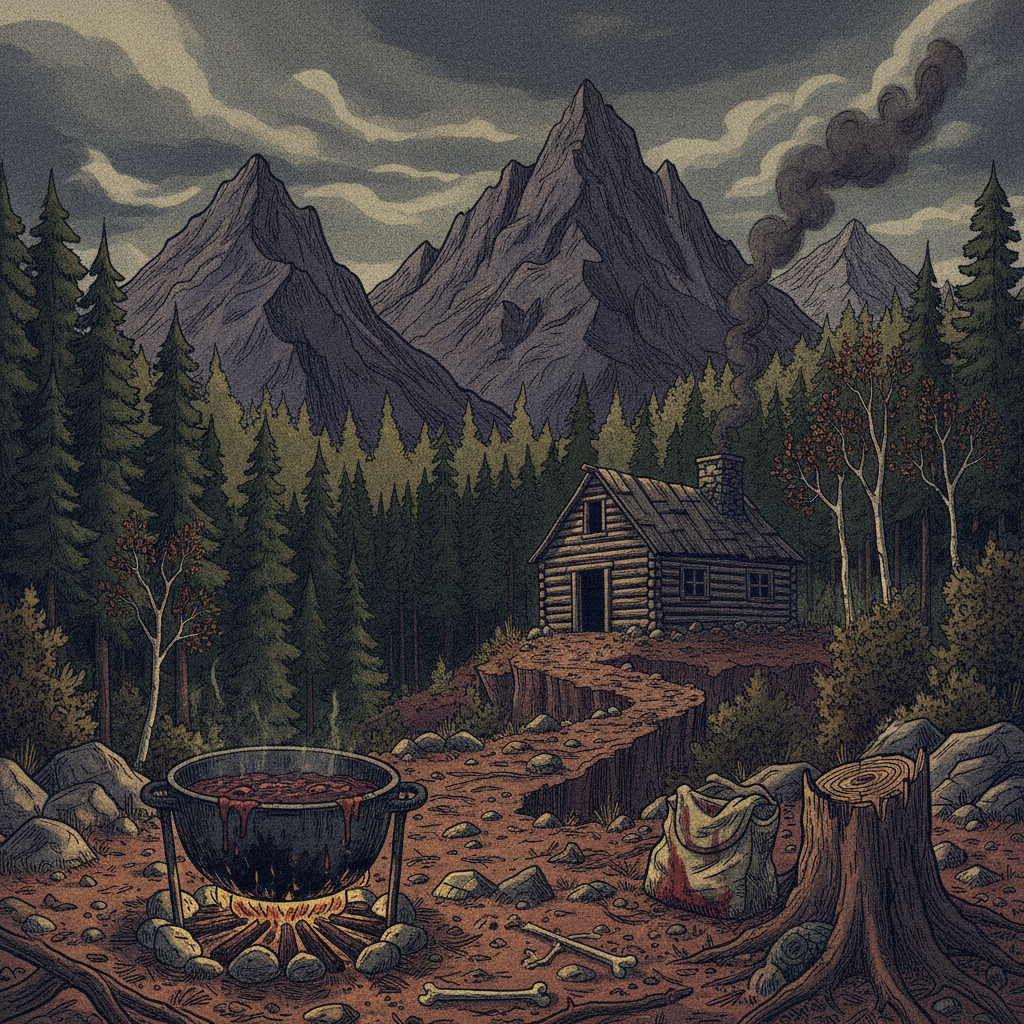
The San Juan Mountains hold their winters like a grudge. Even now, with paved highways and rescue helicopters, a hard snowfall in that country can strand the unprepared for weeks. In the winter of 1874, it killed five men — and left a sixth facing accusations that would follow him, and Colorado, for more than a century.
This is the story of Alferd Packer, the Colorado prospector convicted of killing and eating his companions in the mountains near Lake City. It is a story that doesn’t need embellishment. The historical record — court documents, newspaper coverage, and a 1989 forensic exhumation — is grim enough on its own.
A Party of Twenty-One
In the fall of 1873, Packer joined a group of prospectors heading into Colorado Territory from Utah, chasing rumors of gold near the newly opened San Juan mining district. By the time the party reached the area of present-day Delta, Colorado, winter was closing in fast, and most of the group had the sense to hole up at Chief Ouray’s Ute encampment rather than push on. Ouray reportedly warned them against attempting the mountain crossing to the Los Pinos Indian Agency in the dead of winter.
Packer and five other men — Israel Swan, George Noon, Frank Miller, James Humphrey, and Wilson Bell — ignored the warning, or decided the risk was worth the reward. They set out in February 1874 with barely enough provisions to last a couple of weeks. They did not have enough for the ordeal that followed.
Alone Off the Mountain
Two months later, in April 1874, Packer walked into the Los Pinos Indian Agency alone. According to accounts from the time, he arrived looking suspiciously well-fed for a man who claimed to have survived two months lost in the San Juans on scraps and boot leather. He offered several different explanations over the following weeks for what had happened to his five companions — first claiming the group had simply become separated, then that he’d been abandoned by the others, then that one man, Bell, had gone mad and killed the rest before Packer killed Bell in self-defense and ate his remains to survive.
The stories didn’t hold up, and Packer’s changing account did little to help his case. When search parties eventually located the bodies later that summer near what is now Lake City, in Hinsdale County, the scene told its own story. According to historical accounts from the discovery, the men had been found with evidence of violence beyond what starvation alone could explain, and portions of the bodies appeared to have been removed for food. A famous, and famously grim, photograph taken by photographer John Randolph — showing the remains still arranged where they fell — became one of the era’s most disturbing pieces of frontier documentation.
Packer was arrested but escaped custody in 1874 and vanished for nearly nine years.
Capture, Trial, and Sentencing
Packer was finally recaptured in 1883, living under an assumed name in Wyoming. He was brought back to Colorado and stood trial in Lake City, the county seat of Hinsdale County, where he was convicted of murder. The most enduring piece of Colorado courtroom folklore comes from this trial: the presiding judge, Melville Gerry, is said to have delivered a sentencing rant blaming Packer for wiping out a significant portion of the local Democratic population. The exact wording of that line has been repeated, disputed, and embellished by generations of Colorado historians, and its precise authenticity remains debated — but the conviction and death sentence were real.
Packer’s death sentence was later overturned on a technicality related to the statute under which he’d been charged, and he was retried and convicted instead on five counts of manslaughter, receiving a 40-year sentence. He served time at the Colorado State Penitentiary in Cañon City before being paroled in 1901, in part due to public advocacy from Denver newspaperwoman Polly Pry, who campaigned for his release. Packer died in 1907 near Deer Creek, Colorado, and is buried in Littleton.
The 1989 Exhumation
For more than a century, Packer’s guilt — and the exact nature of what happened on that mountain — remained a subject of dispute among historians. Had he killed all five men, as prosecutors argued? Or was there truth to his claim that he acted in self-defense against Bell, only later resorting to cannibalism out of desperation?
In 1989, forensic scientist James Starrs, a professor at George Washington University known for exhuming historical figures to apply modern forensic techniques to cold cases, led a team that exhumed the remains of the five victims from their burial site near Lake City. The excavation and subsequent bone analysis, widely reported in academic and journalistic accounts, examined cut marks on the skeletal remains to determine how the men had died and how their bodies had been handled afterward.
Starrs’s team concluded that the pattern of cut marks was consistent with defensive wounds and with butchery for consumption, and the findings were largely interpreted as supporting the theory that Packer had killed multiple members of the party rather than acting purely in self-defense against a single aggressor. The study didn’t definitively settle every question about the case — no forensic analysis conducted more than a century after the fact can offer perfect certainty — but it added physical, scientific weight to the historical record in a way that traditional testimony and shifting confessions never could.
A Grim Legacy, Preserved in Trivia
Alferd Packer’s story never really left Colorado’s cultural memory, and it eventually found its way into something far less somber than a Hinsdale County courtroom. The student dining hall at the University of Colorado Boulder is officially named the Alferd Packer Grill, or Alferd Packer Restaurant & Grill, a bit of dark, self-aware campus humor that has stuck around for decades. It’s worth noting clearly here: this is a piece of real, documented Colorado trivia, not folklore about hauntings or unexplained phenomena. There’s no serious body of ghost lore attached to Packer or the Lake City site — his story belongs to the realm of true crime and frontier history, not the paranormal.
Even so, it’s easy to understand why the case has held on. It has all the elements that make Colorado’s weirder history so enduring: a remote, unforgiving landscape; a man whose account of events kept shifting under pressure; a legal system straining to apply order to something almost incomprehensible; and, more than a hundred years later, science stepping in to examine bones for answers the courtroom never fully settled.
The San Juans have swallowed plenty of prospectors over the years. Alferd Packer is the rare one whose story survived him — carried forward first by newspapers and courtrooms, and later by forensic scientists digging, quite literally, for the truth.