
The Hotel de Paris: Georgetown's Haunted Frenchman's Legacy
Inside Georgetown's Hotel de Paris Museum, where founder Louis Dupuy's ghost is said to linger in the halls he built with his own hands.
A Frenchman’s Reinvention in the Rockies
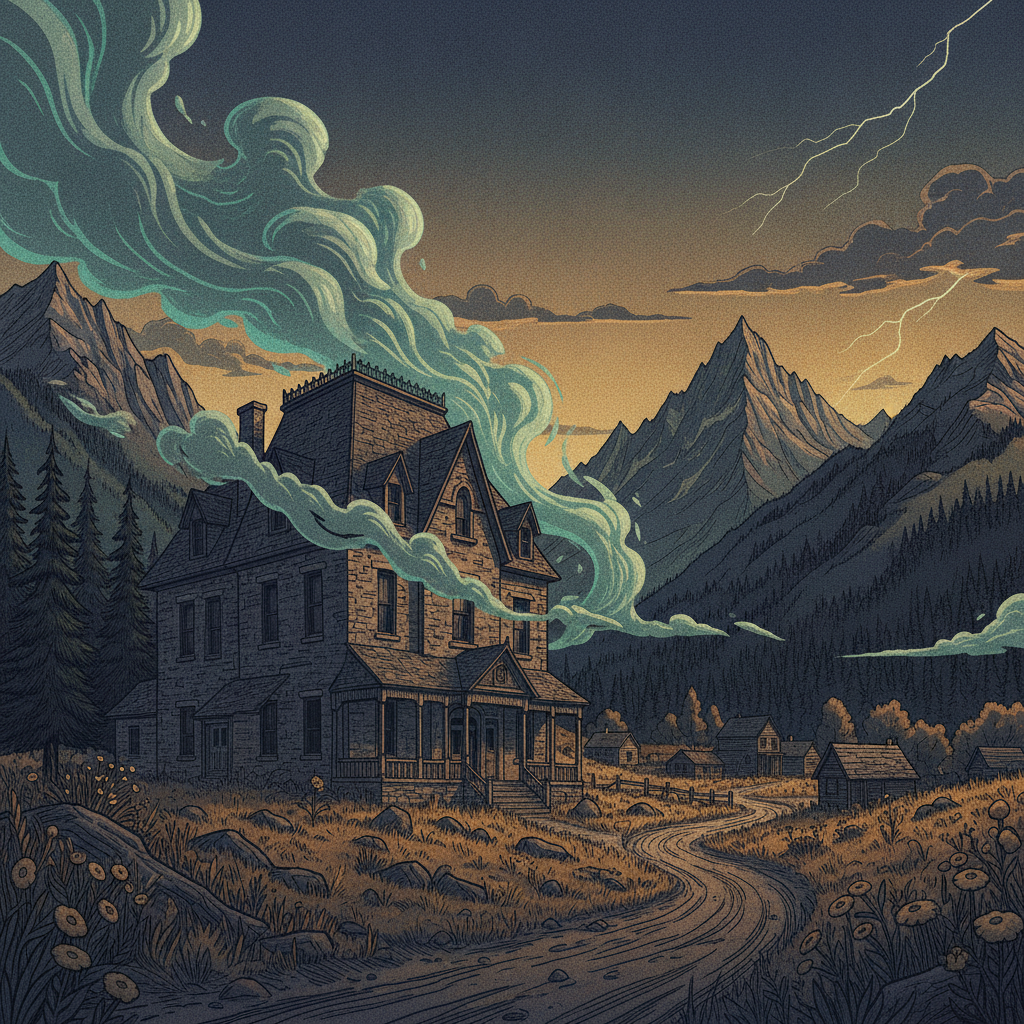
High in Clear Creek County, where Georgetown’s silver-boom architecture still lines the streets like a town caught mid-breath, the Hotel de Paris stands as one of Colorado’s strangest and most meticulously preserved monuments to a single, singular man. Today it operates as a museum under the stewardship of the National Society of Colonial Dames of America in Colorado, its rooms arranged much as they were when its founder last walked them. But long before it became a stop on Georgetown’s historic walking tours, the Hotel de Paris was the obsessive creation of a man who spent his life running from one identity and building another.
That man was born Adolphe Francis Gerard in Alençon, France, in 1844. By the time he reached Colorado, he had shed that name entirely and become Louis Dupuy — a reinvention so thorough that much of what we know about his early life comes only from fragments he chose to reveal, and from records historians have pieced together since. Dupuy emigrated to the United States as a young man and, according to documented accounts of his life, enlisted in the U.S. Army. He deserted. Whatever drove him to walk away from that life, he never fully explained it, and the desertion became the hinge point on which his entire American identity turned. He resurfaced in Colorado’s mining country under his new name, working for a time in the mines around Georgetown before an injury — some accounts point to a mining accident — pushed him toward other work.
Dupuy was, by all documented measures, an unusually literate and cultured man for a Rocky Mountain silver camp. He wrote for local newspapers, read voraciously in several languages, and eventually turned his attention to hospitality, opening the Hotel de Paris in the 1870s after a fire had damaged an earlier bakery and boarding house on the site. What he built in its place was unlike anything else in the district.
An Architectural Oddity Built by One Man’s Hands
The Hotel de Paris that survives today is remarkable partly because Dupuy was, by most accounts, its actual builder — not merely its owner or financier, but the man who designed and constructed much of it himself, importing ideas and materials that had no business being in a Colorado mining town. Visitors and historians have long noted the building’s genuine architectural peculiarities: floors and hallways that don’t quite align, doors that open at odd angles, a central courtyard fountain, and construction details that suggest a self-taught builder working from European sensibility rather than American frontier convention.
Inside, Dupuy furnished the hotel with an extensive personal library, imported wine, and a kitchen that turned out French cuisine considered extraordinary for a mining camp at that altitude. He was, according to the museum’s own preserved record of his life, a demanding and eccentric host — particular about his guests, his menu, and the way his hotel was run. The Hotel de Paris became known throughout the region less as a place to sleep than as a place to experience Dupuy himself: a man who had built an entire European enclave into the heart of the Colorado Rockies, one room at a time, using his own labor.
Dupuy died in 1900, and the hotel eventually passed out of active operation. The National Society of Colonial Dames of America in Colorado has preserved the building as a house museum, maintaining Dupuy’s furnishings, his library, and the layout of the rooms largely as they existed during his lifetime. It’s this preservation — the sense that almost nothing has been rearranged — that gives the Hotel de Paris its particular atmosphere. Walking through it is less like touring a historic site and more like stepping into a home its owner has simply stepped out of.
The Ghost Who Never Checked Out
It’s that unsettling sense of continuity — the untouched rooms, the personal objects, the library he built by hand — that has fed decades of local folklore claiming Louis Dupuy never really left.
According to accounts compiled in Colorado haunted-history and ghost-town guides, staff and visitors to the Hotel de Paris Museum have long reported experiences they attribute to Dupuy’s lingering presence: the sudden smell of pipe tobacco in rooms where no one has been smoking, unexplained footsteps in empty upper hallways, and a persistent feeling of being watched while moving through his old private quarters. Some of the folklore holds that objects in the museum — books in his library, items on his writing desk — are occasionally found disturbed or rearranged overnight, despite the building being locked and unoccupied.
It’s worth being precise about what these claims are and aren’t. There is no scientific documentation of paranormal activity at the Hotel de Paris, and the National Society of Colonial Dames of America in Colorado, which operates the museum, presents the building primarily as a historical and architectural artifact rather than a haunted attraction. The ghost stories exist in the same space as much of Colorado’s mining-town folklore: passed along through local guides, ghost-town compilations, and the kind of oral tradition that attaches itself naturally to any building this old, this well-preserved, and this tied to one unforgettable personality.
But the folklore’s persistence says something on its own. Georgetown is a town built almost entirely on the memory of its silver-boom past, and few figures loom as large in that memory as Dupuy — a deserter who reinvented himself as a European gentleman-innkeeper in the middle of the Rockies, and who built, with his own hands, a monument eccentric enough that people still can’t quite let go of the idea he might still be inside it.
Visiting Georgetown’s Strangest Landmark
Whether or not you believe Louis Dupuy still walks the crooked hallways he built, the Hotel de Paris Museum remains one of the best-preserved windows into 19th-century Colorado mining culture anywhere in the state. Georgetown itself — a National Historic Landmark District — is worth the drive up I-70 on its own merits, but the Hotel de Paris gives that history a face: a strange, brilliant, self-invented Frenchman who built something nobody asked for and everybody remembered.
For paranormal enthusiasts, it sits alongside a long list of Colorado sites — from Denver’s haunted mansions to former mortuaries turned restaurants — where the line between documented history and local legend blurs just enough to keep visitors looking over their shoulder. The Hotel de Paris asks for no belief, only attention: to the uneven floors, the imported furnishings, and the library of a man who spent his whole life becoming someone else — and who, if the stories are true, still hasn’t quite finished the job.