
Central City's Boot Hill: Colorado's Gold Rush Ghosts
Above Central City, a hillside of century-old cemeteries holds the bones of Colorado's gold rush dead — and generations of ghost stories.
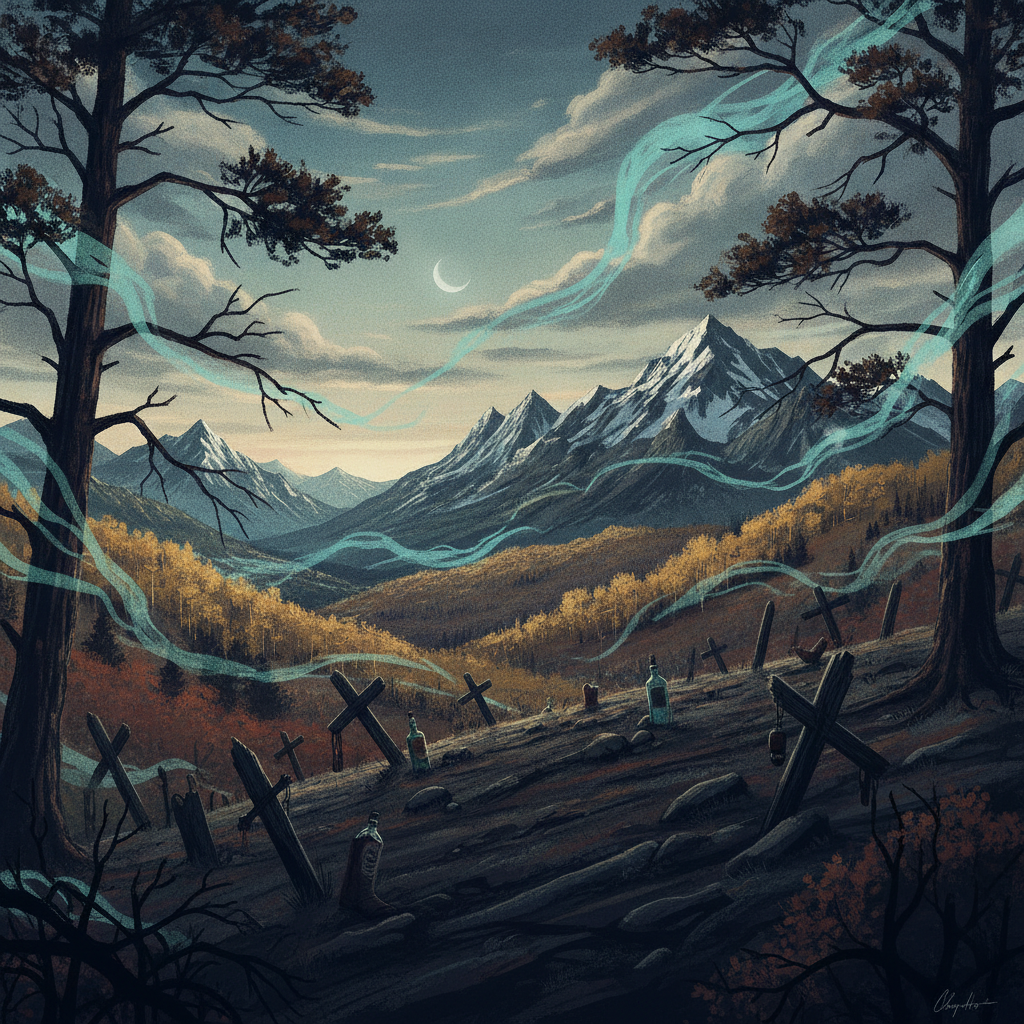
The road up from Central City climbs fast and hard, switchbacking above the old business district until the gulches give way to open hillside and the trees thin out. What waits at the top isn’t a scenic overlook. It’s a city of the dead — acres of tilted headstones, cast-iron fencing gone to rust, and ground so full of graves that Gilpin County long ago simply called it Boot Hill.
The name is common enough in the mining West, a shorthand for graveyards filled with men who, as the saying goes, died with their boots on. But the hillside cemetery complex above Central City is something more specific and more historically rich than the nickname suggests: a sprawling collection of distinct burial grounds — Catholic, Protestant, Masonic, Odd Fellows, Knights of Pythias — stacked and interwoven across the slope, each one a physical record of who mattered to whom in a nineteenth-century gold camp, and how those loyalties outlasted death itself.
A Boomtown Built to Bury Its Dead
Central City exploded into existence during the Pike’s Peak Gold Rush of 1859, after prospector John H. Gregory struck rich placer and lode deposits in the gulch that would bear his name. Within months, thousands of fortune-seekers poured into the narrow mountain valley, and what had been wilderness became one of the most important mining districts in the Colorado Territory — for a time, Central City rivaled Denver itself for population and influence, earning the nickname “the richest square mile on Earth.”
Boomtowns like this were built for extraction, not longevity, and the human cost showed almost immediately. Underground mining in the 1860s through the early twentieth century was brutally dangerous work: cave-ins, explosions, falls down shafts, and the slow poison of silicosis from rock dust took miners young. Add to that the diseases that tore through crowded, poorly sanitized camps — typhoid, diphtheria, smallpox, influenza — along with the violence that came with a town full of armed men, hard liquor, and fast money, and you get a mortality rate that filled graveyards at a pace few Eastern cities of comparable size ever saw. Infant and childhood deaths, too, are a constant, quiet presence in the plots, a reminder that gold rush towns weren’t just populated by single men chasing ore, but by families trying to build a life in a place that often didn’t allow it.
The hillside above town became the answer to a practical problem: where do you put that many dead, that fast, on ground too steep and rocky for much else? The result, over decades, was not one cemetery but many, laid out side by side and sometimes literally on top of one another as space ran short.
A City of the Dead, Organized by the Living
What makes the Central City cemetery complex so valuable historically isn’t just its age — it’s its structure. Walk the hillside and you’re walking through the actual social architecture of a nineteenth-century mining town.
The Catholic cemetery holds the immigrant miners — Irish, Italian, Cornish, and others — who came for the gold and brought their faith with them, ministered to by the small but determined parishes that served Gilpin County’s Catholic population from the earliest boom years. Separate Protestant and nondenominational sections tell a parallel story of the town’s other religious communities.
But it’s the fraternal order plots that offer the clearest window into how a frontier town cared for its own. The Masons, the Independent Order of Odd Fellows (IOOF), and the Knights of Pythias all maintained distinct burial grounds on the hillside, and their presence there reflects something essential about mining town life: in an era before widespread life insurance, workers’ compensation, or reliable social safety nets, fraternal organizations functioned as mutual aid societies. Membership dues bought sick benefits, funeral costs, and — critically — a guaranteed, dignified burial plot among brothers, regardless of whether a man’s family or church back home could pay for the trip out or the stone. For miners far from wherever they’d started life, these lodges were often the closest thing to family they had left. The rows of Masonic square-and-compass symbols and Odd Fellows’ linked-chain emblems carved into weathered headstones aren’t decoration — they’re the record of who took care of Central City’s dead when the town itself was too busy chasing ore to build much of a social safety net on its own.
Legends of the Hillside
Any graveyard this old, this large, and this visibly weathered by more than a century of Rocky Mountain winters is going to accumulate stories — and Boot Hill has done exactly that, passed down through Gilpin County oral history and repeated in the broader literature on Colorado’s ghost towns and mining-era folklore.
The stories follow familiar shapes: cold spots that move against the wind, the sense of being watched among the older Catholic and fraternal plots, sightings of figures near the fence lines at dusk that vanish when approached directly. Some tellings describe children’s laughter near the sections where so many young lives are recorded on the stones — infant mortality being, as noted above, a documented and sobering feature of the burial records themselves, even if the laughter is not. Central City’s ghost-town reputation, tied closely to its well-known haunted landmarks downtown, has made the hillside cemetery a natural extension of the town’s paranormal lore in local guidebooks and regional ghost story collections.
It’s worth being direct about what these stories are and aren’t. There is no documented, verifiable paranormal investigation record, newspaper account, or named witness testimony tying specific supernatural events to the Boot Hill cemetery complex — at least none that meets the bar of verifiable, attributable reporting. What exists instead is folklore: a body of oral tradition, campfire stories, and atmosphere-driven local legend that has grown up around a place that, frankly, doesn’t need embellishment to feel haunted. A hillside covered in leaning, illegible headstones marking thousands of hard, often violent deaths carries its own weight without anyone needing to invent a ghost to explain it.
What the Stones Actually Tell Us
Whatever you make of the legends, the documented history standing on that hillside is remarkable enough on its own. This is one of the most intact records anywhere in Colorado of how a nineteenth-century mining society organized itself — in life through its lodges, churches, and ethnic communities, and in death through the ground it set aside for each. The fraternal order plots in particular preserve something easy to lose in the broader gold rush narrative of strikes and fortunes: the fact that most people who came to Central City didn’t get rich. They worked, they got sick, they got hurt, and eventually they got buried by whichever brotherhood had promised to see them into the ground with dignity.
That’s the real ghost story of Boot Hill — not what may or may not walk the hillside after dark, but the thousands of ordinary, largely unrecorded lives the stones represent. If you visit, and you should — treating the ground with the same respect you’d give any cemetery, active or historic — you’re not just looking for a chill down your spine. You’re looking at one of the clearest surviving maps of who Colorado’s gold rush actually was.