
The Great Diamond Hoax: Colorado's Strangest 1872 Con
How two prospectors salted a remote Colorado mesa with gems and nearly fooled Tiffany's, Wall Street, and the U.S. government.
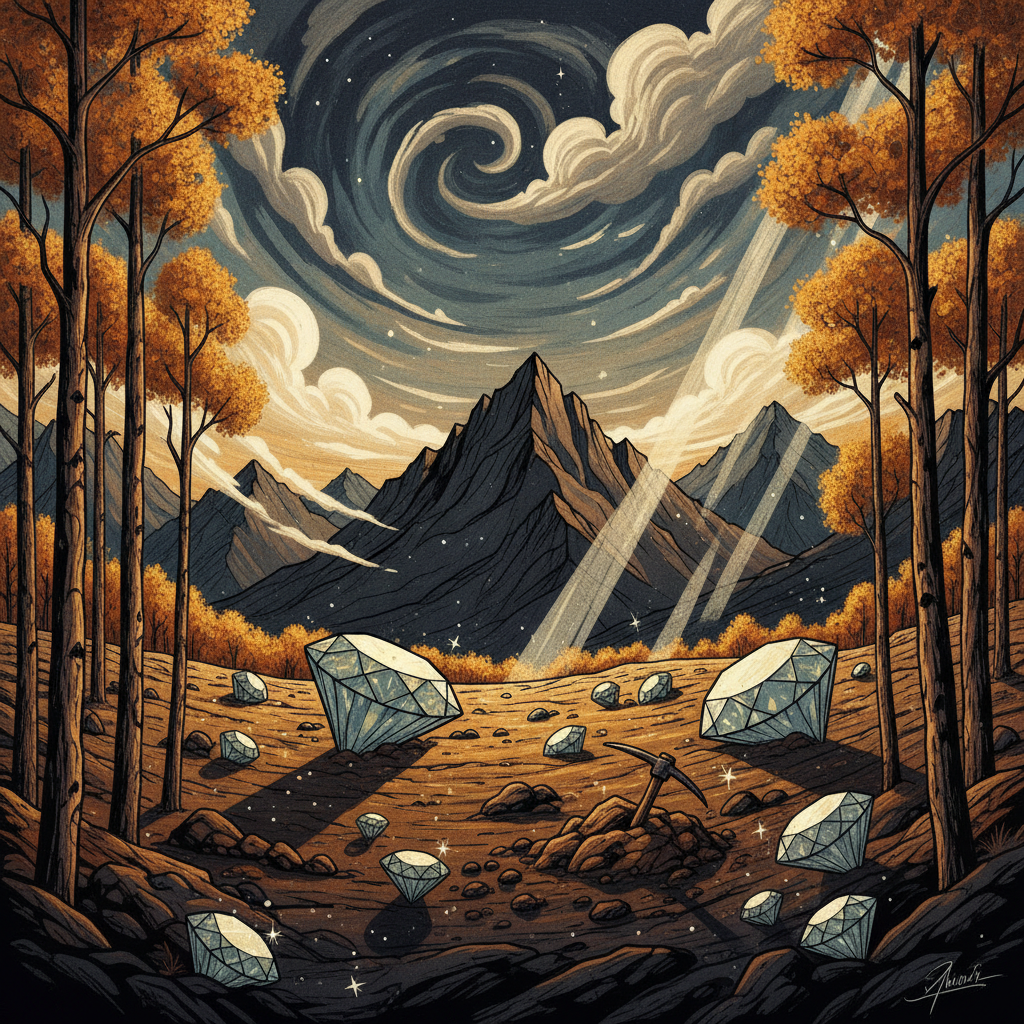
A Barren Mesa and Two Men With a Secret
In the fall of 1872, two grizzled prospectors walked into the Bank of California in San Francisco carrying a leather pouch heavy with uncut diamonds and rubies. Their names were Philip Arnold and John Slack, and the story they told was the kind that had built and destroyed fortunes across the American West for a generation: they’d found a diamond field, somewhere out in the wilderness, rich enough to make Kimberley look like a gravel pit. They wouldn’t say exactly where. That, they said, was the whole point.
What followed was one of the strangest and most audacious confidence schemes in American history — a fraud that would eventually reach into the vaults of Tiffany & Co., the boardrooms of Wall Street, and the highest ranks of the newly formed United States Geological Survey, before unraveling on a lonely, windswept mesa near the Colorado-Wyoming border that today most Coloradans have never heard of.
The Salted Ground
Arnold and Slack were not random drifters. Arnold had worked for a diamond-cutting company in San Francisco years earlier and understood, better than almost anyone in the West, what raw diamonds and rubies actually looked like — and how easily that knowledge could be weaponized against men who had never seen one in the rough.
The two men had, according to the well-documented historical record, purchased a stockpile of low-grade uncut diamonds, rubies, and other gems on the open market — some accounts point to South Africa and India as sources for these secondhand stones. They then traveled to a remote, high desert mesa in what is now northwestern Colorado, near the Wyoming line, and salted the ground: scattering gems into anthills, burying them in shallow pits, scuffing them into rock crevices where a “prospector” might plausibly stumble upon them.
Then they went looking for investors — and found some of the most powerful men in America.
Wall Street Takes the Bait
The pouch of gems that landed on a San Francisco banker’s desk set off a chain reaction that historians have compared to a gold rush in miniature. Word spread to financiers and mining men eager not to miss the next great American bonanza. Among those who took the bait, according to the historical record, was General George B. McClellan — the former Union Army commander and 1864 presidential candidate — who lent his name and reputation to the venture. Investors including banking figures tied to the Rothschild family and other prominent East Coast financiers poured money into what became known as the San Francisco and New York Mining and Commercial Company, capitalized at a reported $10 million, an almost unfathomable sum for the era.
But the deal that gave the hoax its aura of legitimacy — and its lasting fame — was the involvement of Charles Lewis Tiffany, founder of Tiffany & Co. Investors, wanting expert verification before committing further capital, brought a sample of the stones to Tiffany, who was widely regarded as the nation’s foremost authority on gems. Tiffany examined the stones and pronounced them genuine and valuable, reportedly appraising the sample at a startling figure. For men already inclined to believe, the word of America’s most famous jeweler was as good as a deed to the mine itself.
Investors demanded to see the diamond field itself. Arnold and Slack, playing the part of reluctant, suspicious frontiersmen, agreed to lead a small party out — blindfolded for much of the journey, by some accounts — to the site in the remote high country. What they found stunned them: diamonds and rubies practically littering the ground, visible in the dirt, wedged into rock. The investors dug with their hands and came up with gems. It seemed impossible that anyone could fake something on this scale, in a landscape this desolate and hard to reach.
That, of course, was exactly the point.
Clarence King and the Faceted Stone
The unraveling came from an unlikely direction: government science.
Clarence King, the young, brilliant head of the newly established U.S. Geological Survey of the Fortieth Parallel, had spent years mapping the geology of the exact region where the “diamond field” was supposedly located. When he heard reports of a diamond bonanza in territory he knew intimately — and knew, geologically, made no sense for producing such gems — he grew suspicious enough to investigate personally.
In November 1872, King and a small survey team located the site and began examining it with a trained geologist’s eye rather than a speculator’s greed. The ground did contain diamonds and rubies, just as promised. But King noticed something the investors had missed: the stones appeared in patterns no natural diamond field would produce — concentrated in disturbed soil, in anthills, in spots that seemed almost too convenient. Digging further, King’s team found something the con men hadn’t managed to hide: several stones showed signs of having already been cut and faceted by human hands, evidence that the “raw” gems were secondhand stock salted onto the land rather than natural deposits waiting to be discovered.
King’s report exposed the fraud publicly. The company collapsed almost overnight. Investors who had poured fortunes into the scheme were left holding worthless stock, and the reputations of respected men — including, awkwardly, Charles Tiffany — took a public battering for having been fooled by a scheme built on nothing more than store-bought gems and a barren mesa.
Arnold and Slack, remarkably, largely got away with it. Arnold returned to Kentucky, reportedly settled a lawsuit from investors for a fraction of what he’d taken, and lived out his life in relative comfort. Slack disappeared from the historical record almost entirely, his later life a matter of conjecture rather than documentation.
The Mesa That Forgot Its Own Story
What’s strangest, perhaps, isn’t the fraud itself but how thoroughly the physical place at the center of it faded from memory. The exact site — a remote stretch of high desert mesa country along the Colorado-Wyoming border — was significant enough in 1872 to draw Union generals, Wall Street bankers, and the founder of America’s most famous jewelry house into its dirt. Today it survives mostly as a footnote, a location historians still debate with more precision than the general public ever cared to remember, swallowed back into the same empty, windswept landscape that made the con possible in the first place.
There’s something fitting, and a little eerie, in that obscurity. The Great Diamond Hoax worked precisely because so few people had ever been to that stretch of Colorado high country, and even fewer understood what they were looking at when they got there. The landscape did the lying as much as Arnold and Slack did — a barren mesa dressed up, for one brief and improbable season, as one of the richest places on Earth.
A Uniquely Colorado Kind of Strange
The Great Diamond Hoax of 1872 endures as one of the most audacious confidence schemes in American history, not because it involved ghosts or gods or unexplained lights in the sky, but because it reveals how easily the extraordinary can be manufactured — how a handful of secondhand gems, a remote and unverifiable landscape, and the right air of reluctant secrecy could fool some of the sharpest financial minds in the country.
It’s a reminder that Colorado’s strangest stories aren’t always supernatural. Sometimes the most unsettling history is entirely human: two men, a bag of stones, and a mesa quiet enough to keep their secret for just long enough.