
Blucifer: The Blood Curse Behind Denver Airport's Demon Horse
The true story behind DIA's glowing-eyed mustang statue, its creator's tragic death, and how a public art piece became Colorado's most infamous urban legend.
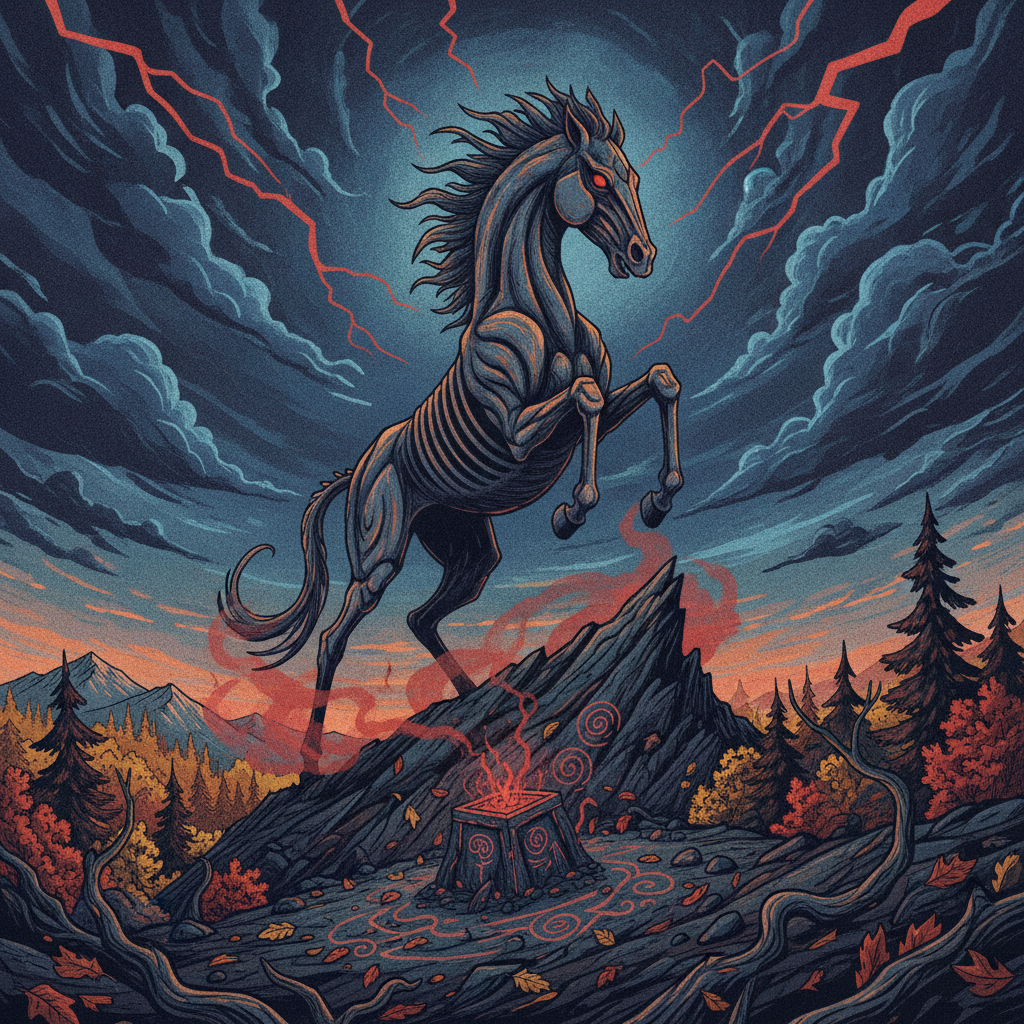
A 32-Foot Shadow Over Peña Boulevard
Every driver who has made the long approach to Denver International Airport along Peña Boulevard has met its gaze. Rising from a traffic median near the airport entrance, a 32-foot fiberglass mustang rears on its hind legs, cobalt blue, veins bulging beneath its skin, eyes glowing an unsettling red at night. Officially, it’s titled “Mustang.” Unofficially, and almost universally, it’s known as Blucifer — a nickname that fuses its color with the devil himself.
For a piece of public art commissioned to celebrate Colorado’s frontier heritage, the mustang has instead become the centerpiece of one of the state’s most enduring urban legends. But before the legend, there was a tragedy — a real one, documented in newspapers across the country. Understanding Blucifer means separating what actually happened in a New Mexico studio in 2006 from what folklore has built on top of it in the years since.
The Artist Behind the Horse
The sculpture was the work of Luis Jiménez, a celebrated Mexican-American artist from El Paso, Texas, known for his large-scale fiberglass sculptures finished in bright, almost lacquered automotive paint. Jiménez had built a national reputation working in this medium, and his pieces often depicted mythic, larger-than-life figures rooted in the American Southwest — cowboys, migrant workers, and animals rendered with exaggerated muscle and motion. The Denver mustang was conceived in that same spirit: a tribute to the wild horses that once roamed the plains where the airport now sits, commissioned by the Denver Arts & Venues public art program.
Jiménez worked on the sculpture for years in his studio in Hondo, New Mexico, building it in sections due to its enormous size.
The Accident
In June 2006, while Jiménez and studio assistants were working to move one of the sculpture’s massive sections, a piece of the horse broke loose from a hoist and fell on him. The sculpture severed an artery in his leg, and Jiménez bled to death before he could be saved. His death was widely reported at the time, including by the Associated Press and the Denver Post, as an accident during fabrication — a tragic workshop mishap involving heavy industrial equipment and an unfinished piece of art, not any kind of mysterious or unexplained event.
Jiménez never saw his mustang installed at DIA. The sculpture was completed posthumously by his family and studio associates, honoring his original design, and it was finally installed near the airport entrance in February 2008 — nearly two years after his death and roughly a decade after Denver Arts & Venues first commissioned the piece.
From Grief to Ghost Story
It’s worth pausing here on what is fact and what is not. The documented record is this: an artist died in a construction accident while building a large public sculpture, and that sculpture was later installed at one of the busiest airports in the country. That is tragic, but it is not, on its own, supernatural.
What happened next is a matter of public perception rather than public record. Almost immediately after Mustang went up, Denver residents began reacting to its appearance — the flared nostrils, the bulging veins, the wild-eyed stare, and especially the LED eyes that glow crimson after dark. Local media covered public backlash and petitions calling for its removal, with commenters describing it as demonic, nightmarish, or simply too intense for a welcome to the Mile High City. The nickname “Blucifer” took hold in local slang and eventually spread nationally as the statue became a talking point in listicles about the world’s creepiest public art.
From there, the folklore did what folklore does: it filled in the gaps between coincidence and meaning. Jiménez’s death during the statue’s creation became, in popular retelling, a “curse” — as though the sculpture itself had claimed its maker before ever standing upright. Some tellings go further, framing the horse’s glowing eyes and aggressive posture as intentional occult symbolism, evidence of a dark agenda embedded in DIA’s public art. None of this is supported by anything Jiménez said about his own work.
What the Artist Actually Intended
Jiménez was known throughout his career for sculptures that captured raw, kinetic energy — bucking broncos, snarling wildlife, straining human figures — rendered in bold, saturated color rather than realistic tones. His mustang fits squarely within that established style: an artist rendering a powerful, untamed animal in the same dramatic visual language he’d used for decades on works installed in cities across the Southwest. The blue coloring, the exaggerated veins, and the wide eyes are consistent with Jiménez’s broader body of work, not unique markers designed for this piece alone.
There is no documented statement from Jiménez describing the mustang as demonic, cursed, or symbolically dark. The reading of the sculpture as sinister appears to be almost entirely a product of public reaction after installation, amplified by the coincidence of his death during its fabrication — an emotionally potent but factually separate event that folklore has since fused into a single narrative of doom.
Part of a Larger Airport Mythology
Blucifer doesn’t exist in isolation. DIA has developed a broader reputation in Colorado urban legend circles as a site of unexplained oddities — from its unusual gargoyle-topped luggage sculptures inside the terminal to murals depicting apocalyptic imagery that have spawned their own decades of visitor speculation. Blucifer fits neatly into that ecosystem: a genuinely unsettling piece of public art, installed at an airport already primed by other strange installations to be read as more than it is. Whatever your theory about DIA’s murals or design choices, the mustang’s story stands apart because at its center is a real, verifiable human tragedy — not a hidden message, but the death of a working artist who never got to see his final piece completed.
A Legend That Outgrew Its Facts
Nearly two decades after its installation, Blucifer remains one of the most photographed, memed, and debated pieces of public art in the country. Travelers stop on the shoulder of Peña Boulevard for photos. True crime and paranormal podcasts return to it regularly. And every telling seems to add a little more embellishment to the “curse” — details about the sculpture supposedly “wanting” to fall, or claims that its creation was doomed from the start.
The truth, as documented at the time, is both simpler and sadder: a talented sculptor died in an industrial accident while building a piece of art that he intended as a tribute to Colorado’s wild-horse heritage. The rest — the demon eyes, the blood curse, the sense that Denver’s airport welcomes visitors with a monument to something dark — is the layer Colorado has added since, one retelling at a time. It’s a reminder that some of the best urban legends don’t need embellishment to be haunting. Sometimes the real story is unsettling enough on its own; it’s just that the legend is more fun to tell.