
Spirit Lake: The Ghostly Legend Haunting Grand Lake, Colorado
A German tourist's 'Loch Ness' sighting revives interest in lake monsters — but Colorado has its own centuries-old haunted lake legend at Grand Lake.
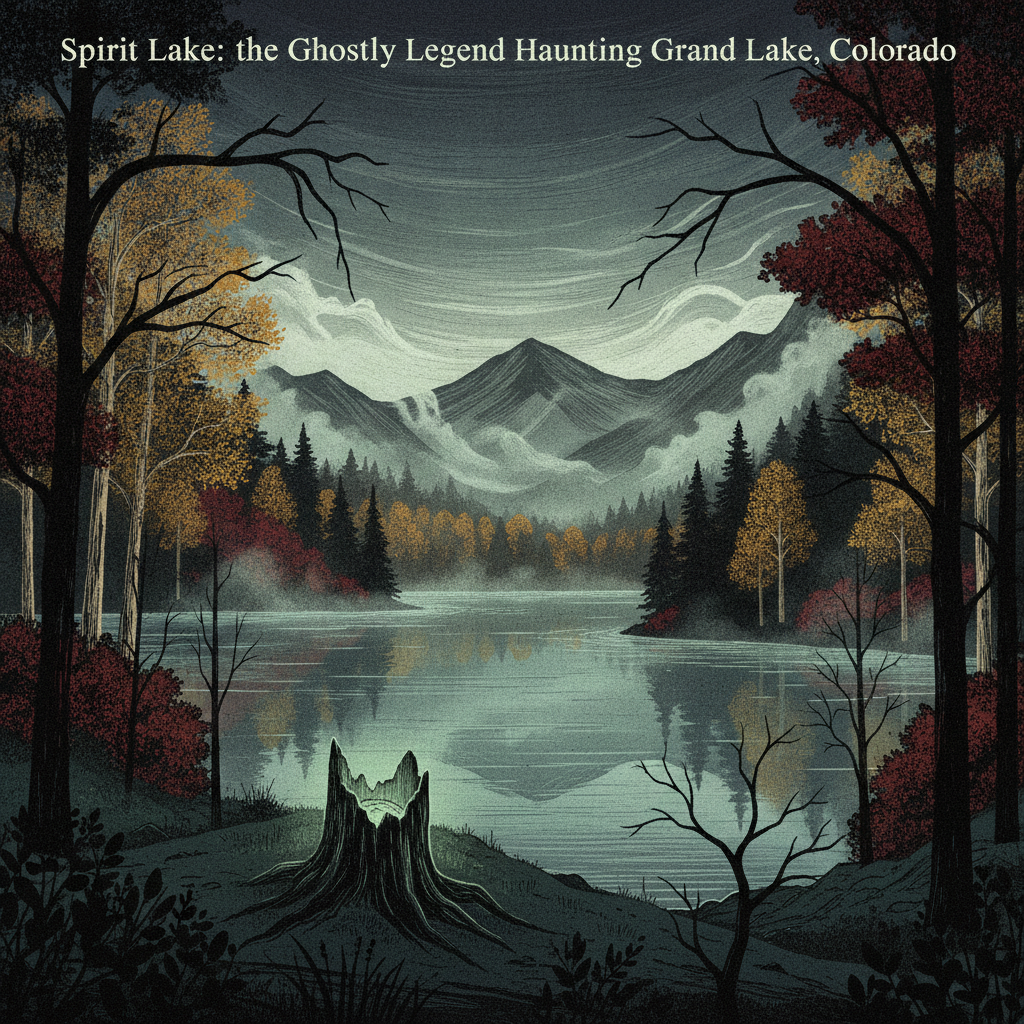
The recent Coast to Coast AM segment on KOA 850 AM & 94.1 FM, in which a German tourist reportedly claimed to have spotted something resembling the Loch Ness Monster, has reignited a familiar public fascination: the idea that our lakes might be hiding something ancient, something watching from beneath the surface. Loch Ness has held that particular grip on the public imagination for nearly a century, and every fresh sighting, however unverified, sends ripples through paranormal media and skeptics alike.
But you don’t have to fly to Scotland to find a lake wrapped in ghost stories. Colorado has one of its own — a high-altitude body of water so steeped in tragedy and legend that its very name is a translation of a Ute phrase meaning “Spirit Lake.” Long before anyone in the Rockies had heard of Nessie, the waters of Grand Lake were already said to hold the restless dead.
Colorado’s Largest Natural Lake — and Its Darkest Legend
Grand Lake sits at roughly 8,369 feet in Grand County, on the western edge of Rocky Mountain National Park. It’s the largest natural lake in Colorado, a deep glacial basin ringed by pine forest and granite peaks, and today it’s better known for boating, summer tourism, and the charming boardwalk shops of the town that shares its name. But according to local histories preserved by the Grand County Historical Association and repeated in regional tourism and heritage accounts for generations, the lake carries an origin story far darker than its postcard scenery suggests.
Oral tradition attributed to the Ute people who inhabited the area holds that the lake was the site of a violent conflict — most versions describe a raid or battle with a rival tribe, sometimes identified in local retellings as Arapaho or Cheyenne warriors. As the story goes, the Ute women, children, and elders were placed on a makeshift raft and pushed out onto the lake under cover of fog, an attempt to keep them safe from the fighting on shore. A sudden storm rose over the water. The raft capsized, and those aboard drowned in the cold, deep lake.
It’s important to be clear about what this is: oral folklore passed down and later recorded by settlers and historians, not a documented historical event with contemporary written records from the period. Like much Indigenous oral history that was filtered through non-Native chroniclers in the 19th and early 20th centuries, the exact details — who the attackers were, when it happened, how many died — vary between retellings and can’t be verified as historical fact in the way a newspaper account or government record could be. What can be verified is that this legend has been consistently recorded and published in Grand County historical materials for well over a century, and it is the reason many local histories give for the name “Spirit Lake” being applied to the waters, with “Grand Lake” later becoming the name of both the lake itself, more broadly, and the town that grew on its shore.
The Mist That Won’t Leave
The detail that keeps this legend alive isn’t the battle — it’s what people claim happens on the water afterward.
According to the folklore, a mist frequently rises off Grand Lake in the early morning and at dusk, drifting low over the surface in a way that local storytellers have long connected to the spirits of those who drowned. Longtime residents and visitors have described the sight as unsettling, even eerie, particularly on still mornings when fog clings to the water and muffles the sound of the shoreline. Whether that mist is anything more than the ordinary result of a cold alpine lake meeting warmer air — a phenomenon common on high-altitude bodies of water throughout Colorado — is, of course, a matter of atmospheric physics rather than the supernatural. But the folklore has proven durable precisely because the natural conditions of the lake keep producing the very imagery the legend describes.
That combination — a real tragedy (real in the sense that oral tradition insists it happened, even if unverifiable in written record), a real physical phenomenon, and generations of storytelling — is exactly the kind of atmosphere that turns a body of water into a place with a reputation. It’s not unlike how the Loch Ness legend itself took hold: a genuinely deep, dark, cold body of water; a handful of sightings that couldn’t be conclusively explained or debunked; and a story old enough to feel like inherited truth rather than invented tale.
Not Colorado’s Only Haunted Water Story
Grand Lake’s legend doesn’t exist in isolation. Colorado has a broader tradition of folklore tied to its wilder, more remote geography — the Denver Gazette has reported on the so-called “Bermuda Triangle of the West,” a stretch of the state associated with decades of strange disappearances, UFO folklore, and unexplained phenomena. Grand County and the high country around Rocky Mountain National Park sit well within the general region where such stories tend to cluster, adding another layer to Grand Lake’s reputation as a place where the ordinary rules feel a little thinner.
It’s worth noting, too, that Colorado’s paranormal landscape has been unusually active in recent memory on an entirely different front — the federal government has been declassifying batches of UAP files that include sightings over Colorado Springs, and outlets from Denver7 to CBS News have covered the steady drip of Pentagon disclosures throughout 2025 and 2026. None of that is directly connected to Grand Lake’s legend, but it speaks to a state where the line between documented mystery and inherited folklore keeps getting blurrier — and where the appetite for both keeps growing.
What We Actually Know — and What We Don’t
Here’s what can be said with confidence: Grand Lake is real, it is Colorado’s largest natural lake, and the name “Spirit Lake” tied to a Ute legend of drowned women and children is a genuine piece of documented regional folklore, recorded by local historical organizations and repeated in Grand County heritage materials for generations. What cannot be verified is the historical accuracy of the underlying event — there is no contemporary written record from the time period confirming the specific battle, the tribes involved, or the number of dead. Like most oral tradition, it exists as story before it exists as fact.
That distinction matters. A German tourist’s Loch Ness sighting, discussed on Coast to Coast AM, is a claim about a present-day encounter that either happened or didn’t, and can in theory be scrutinized, photographed, or debunked. Grand Lake’s legend is different in kind — it’s a piece of inherited cultural memory, shaped by loss and told through mist rising off cold water, that has survived not because anyone can prove it, but because the lake itself seems to keep telling it every morning the fog comes in low over the shore.
Next time you’re driving through Grand County at dawn and catch that pale haze drifting across the water, you won’t be able to prove what it is. But you’ll understand, at least, why the people who named this lake called it Spirit Lake — and why, more than a century later, the story still hasn’t let go.