
Gold Camp Road: The Ghost Tunnel Legend Haunting Colorado Springs
Explore the real 1988 tunnel collapse and decades of ghost stories that turned Colorado Springs' Gold Camp Road into a legendary haunted drive.
A City Already in the Spotlight
Colorado Springs has had a strange year. Between the Pentagon’s declassified UAP files, the CIA’s own archived account of a “frightening” sighting over Colorado, and the ongoing drip of newly unclassified orb and disc photographs from federal agencies, the city has found itself at the center of the nation’s UFO conversation. Denver7 and the Colorado Springs Gazette have both reported on new government files that include sightings recorded above the city, adding another chapter to a region already tied to the so-called “Bermuda Triangle of the West” reputation that stretches down into the San Luis Valley.
But long before the skies over El Paso County made headlines, the ground beneath Colorado Springs had already earned its own reputation for the unexplained. You don’t need a satellite or a federal records request to find it — just a stretch of gravel switchbacks carved into the western foothills, still known by the name locals have used for more than a century: Gold Camp Road.
From Railroad Grade to Ghost Road
Gold Camp Road wasn’t built as a road at all. It began as the grade for the Colorado Springs and Cripple Creek District Railway, a line constructed around the turn of the 20th century to move ore, equipment, and people between Colorado Springs and the booming gold fields of Cripple Creek and Victor. The line was popularly known as the “Short Line” because it cut a more direct route through the mountains than its rival railroads, threading through a series of tunnels blasted directly into the granite of the front range.
The Short Line eventually ceased rail operations, and by the mid-20th century the old railbed had been converted into an automobile road, preserving many of the original tunnels carved by the railway’s construction crews decades earlier. That conversion is what gave Gold Camp Road its unusual character: a narrow, winding mountain drive that passes through hand-cut rock tunnels, hugging cliff edges above canyons that once carried steam locomotives instead of pickup trucks.
It’s a genuinely striking piece of Colorado industrial history — and it’s also the reason the road has been whispered about for generations.
The 1988 Collapse That Changed Everything
The turning point in Gold Camp Road’s transformation from historic curiosity to full-blown ghost-story destination came in 1988, when a partial collapse occurred at Tunnel 3, one of the original railway bores along the route. The collapse rendered the tunnel unsafe for vehicle traffic and led to the closure of that section of the road for an extended period while engineers assessed the stability of the old rock cuts.
This is the documented, verifiable core of the legend: a real structural failure, in a real century-old tunnel, on a road built atop a real 19th-century railway grade. Colorado Springs media outlets, including the Gazette and the Colorado Springs Independent, have covered the collapse and its aftermath repeatedly over the years as the closure stretched on and the road’s reputation grew stranger with each passing season.
What’s important — and what any honest accounting of this legend has to acknowledge — is that the collapse itself was an engineering event, not a paranormal one. Century-old hand-dug tunnels built through fractured granite are simply prone to structural failure over time. There is nothing in the historical or engineering record suggesting the collapse was anything other than what aging infrastructure eventually does.
Where the Ghost Stories Took Over
It’s what happened after the collapse that turned Gold Camp Road into one of the Front Range’s most enduring urban legends.
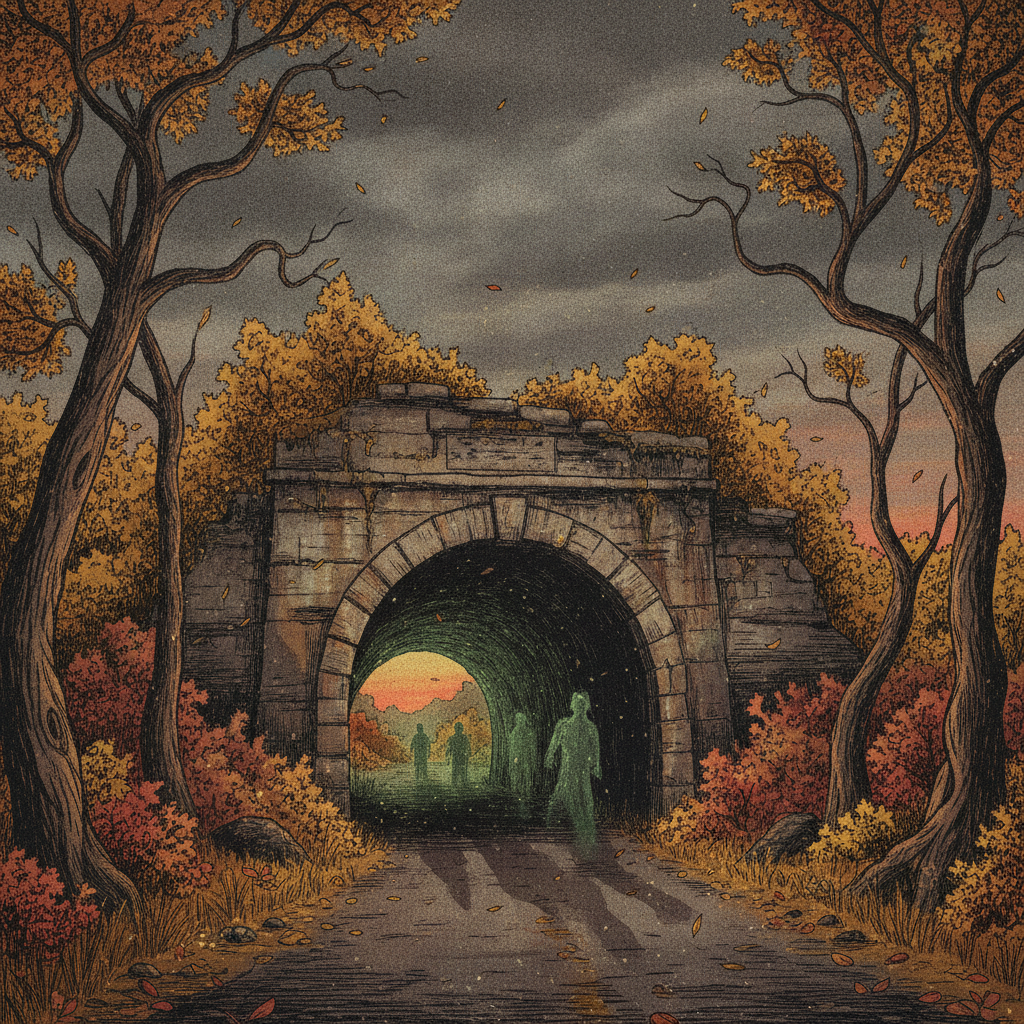
With Tunnel 3 closed and a stretch of the old railway grade abandoned to darkness and disrepair, the road became fertile ground for the kind of folklore that grows around any isolated, history-soaked place. Over the decades, locals and legend-trippers have circulated stories of phantom miners glimpsed near the tunnel mouths — spectral figures said to be laborers who died during the railway’s brutal construction through solid rock. Others report the sound of engines that shouldn’t exist: the distant chug and whistle of a steam locomotive on a line that stopped running as a railroad generations ago. Drivers have described their own vehicles inexplicably stalling near the tunnels, only to restart moments later with no mechanical explanation. Some visitors claim to have seen shadowy figures at the tree line, or felt an overwhelming sense of being watched while passing through the darkened tunnel bores.
These accounts have circulated for years in local reporting and word-of-mouth tradition, cementing Gold Camp Road’s place alongside sites like Denver’s Peabody-Whitehead Mansion and Ophelia’s Electric Soapbox as fixtures of Colorado’s paranormal landscape. It’s worth being direct here: none of these ghost sightings are independently documented or verifiable in the way the 1988 collapse is. No named witnesses, official investigations, or physical evidence back the phantom-miner and ghost-train stories — they exist in the realm of oral tradition and local legend, the way most great American ghost stories do. That doesn’t make them worthless as folklore; it just means they should be understood as exactly that.
Fact, Folklore, and the Space Between
What makes Gold Camp Road such a compelling case study isn’t that it proves anything supernatural — it’s that it shows, in real time, how a legend gets built. You have a genuine historical foundation: a 19th-century mining railroad, a workforce that faced real and often deadly danger blasting tunnels through mountain granite, and a documented 1988 structural collapse that closed part of the route for years. Layer onto that the isolation of a mountain road at night, the eerie acoustics of century-old tunnels, and decades of travelers eager to feel a chill — and you get exactly the kind of self-reinforcing legend that spreads for generations.
Some researchers and longtime residents point to the deaths of railway workers during the line’s original construction as the folkloric root of the “phantom miner” stories, though there’s no verified documentation tying specific incidents to specific hauntings — it remains speculation passed down as local color rather than established history.
A Fitting Companion to Colorado’s Skies
With Colorado Springs currently drawing national attention for declassified UAP sightings recorded above the city, it’s worth remembering that the region’s reputation for the unexplained isn’t limited to what’s happening overhead. Gold Camp Road has been quietly building its own legend for more than a century, out of real history, real engineering failure, and the very human instinct to fill dark tunnels with stories.
Whether you drive it for the history, the scenery, or the chance of feeling that particular chill that comes from passing through a hand-cut rock tunnel after dark, Gold Camp Road remains one of Colorado’s most enduring reminders that you don’t need a UFO file to find a good Colorado ghost story — sometimes all you need is an old railroad grade and a tunnel that once gave way.