
Cripple Creek's Hotel St. Nicholas: A Miners' Hospital That Never Emptied
Once a mining-era hospital, Cripple Creek's Hotel St. Nicholas hostel is steeped in ghost lore Coloradans are still sharing today.
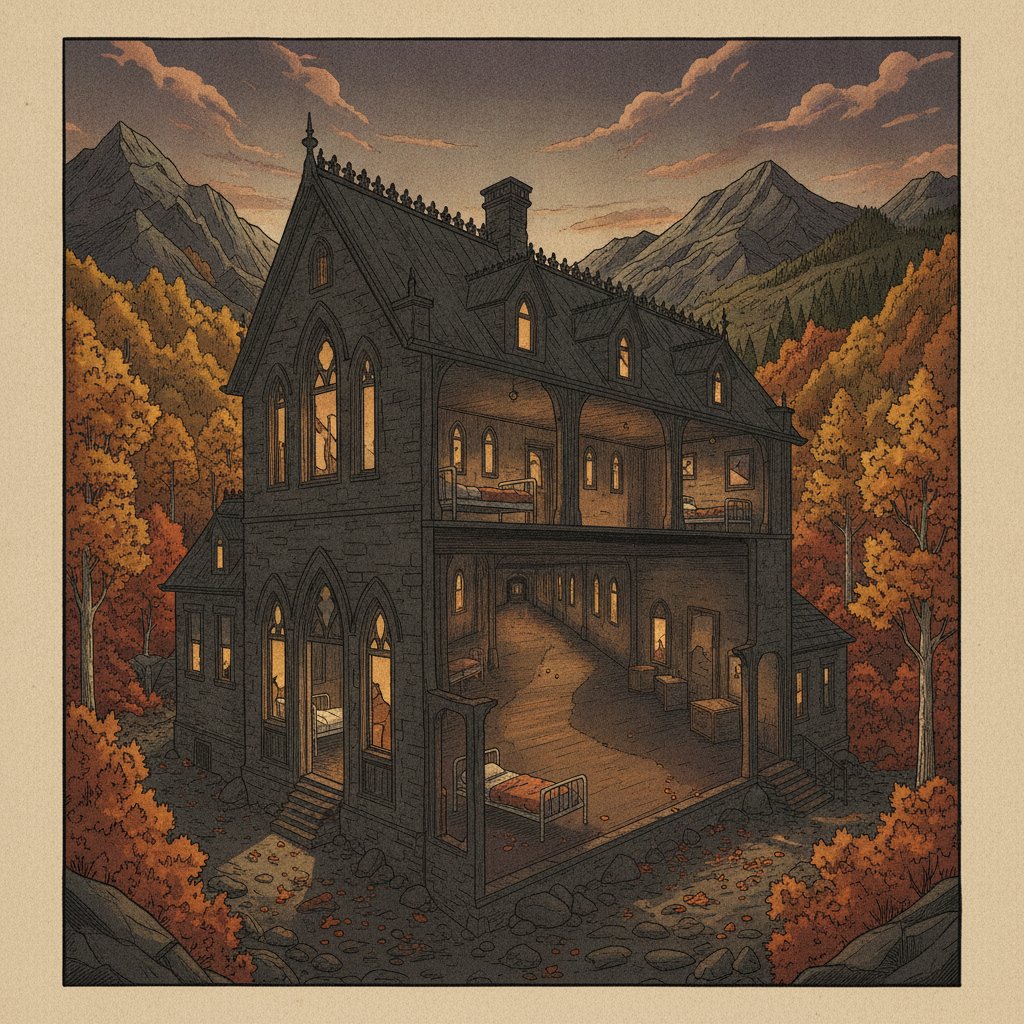
A Statewide Call for Colorado’s Ghosts
Colorado Public Radio put out an open call this September, asking listeners to share their ghost stories, urban legends, and strange tales from around the state. It’s the kind of invitation that tends to open floodgates — because in Colorado, nearly every mountain town has at least one building where the past refuses to stay quiet. Old mining camps, abandoned asylums, saloons turned restaurants, mansions with unresolved histories — the state’s boom-and-bust past left behind hundreds of structures soaked in hard living and harder dying.
Few buildings fit that description more precisely than the Hotel St. Nicholas in Cripple Creek. Long before it offered a bed to backpackers and history tourists, it was a hospital built to patch up men broken by one of the richest gold booms in American history. And for more than a century, locals have insisted that not everyone who died there ever really left.
From Gold Camp to Hospital Ward
Cripple Creek exploded into existence after gold was discovered in the district in 1891, transforming a quiet ranching valley into one of the last great gold rushes of the American West. At its peak, the district’s mines produced staggering wealth — and staggering numbers of injuries. Hardrock mining in the 1890s meant black powder blasts, collapsing shafts, runaway ore cars, and the ever-present risk of falls into vertical workings hundreds of feet deep. Pneumonia, typhoid, and the general hazards of a raw boomtown added to the toll.
To meet that need, St. Nicholas Hospital was built in 1899, during the peak years of the district’s mining boom. Cripple Creek and its satellite towns supported multiple medical facilities in this era, a reflection of just how dangerous the work in the district’s mines truly was. Hospitals like St. Nicholas weren’t peripheral institutions — they were essential infrastructure in a district where injury and death were routine hazards of the job.
As Cripple Creek’s population and mining output declined in the 20th century — following the familiar arc of boomtowns across the Rockies — many of the district’s grand Victorian-era buildings were repurposed or abandoned outright. The St. Nicholas building survived by adapting, eventually being converted into lodging and operating today as a hostel-style hotel that leans into its unusual origin story rather than hiding it. The building’s bones — its layout, its age, its original purpose — remain part of its identity and its marketing as a historic Cripple Creek property.
That transformation, from a place where the mining district’s injured and dying were brought for treatment into a place where travelers now sleep, is the documented, factual spine of the building’s story. Everything beyond that — the sounds, the cold spots, the shapes reported in hallways — belongs to a different category: local lore, passed down the way ghost stories always are, guest to guest, employee to employee, generation to generation.
The Lore That Grew From the Walls
Buildings that once served as hospitals carry a particular weight in ghost lore, and it’s not hard to understand why. A hospital built to serve an entire mining district in an era before modern antibiotics, sterile trauma protocols, or advanced surgical intervention would have seen its share of suffering — and its share of loss. That history alone is enough to seed generations of stories, independent of anything that can be verified.
Locally, the Hotel St. Nicholas has developed a reputation, discussed among Cripple Creek residents and repeated in regional ghost-tour and travel circles, for unexplained phenomena tied directly to its hospital-era past: footsteps in empty hallways, cold spots that seem to move independently of drafts or HVAC systems, and reports from guests and staff of shadowy figures glimpsed at the edges of rooms once used as wards or operating spaces. Some accounts describe the sensation of being watched in areas of the building associated with its medical history.
None of these accounts constitute verified paranormal evidence — they are anecdotal, subjective, and, as with most reportedly haunted locations, impossible to independently confirm. But they are also genuinely and persistently told, which is its own kind of historical fact. The stories exist. People keep telling them. And that pattern — a building’s traumatic original purpose becoming the seedbed for decades of ghost lore — repeats across Colorado in remarkably consistent ways.
Why These Stories Keep Getting Told
Colorado Public Radio’s call for ghost stories is really an acknowledgment of something researchers and folklorists have long understood: hauntings are as much about community memory as they are about the supernatural. A building like the Hotel St. Nicholas doesn’t need embellishment to feel unsettling. Its real history — hundreds of injured miners passing through its doors, a district where death was routine, a boomtown’s medical frontline — does the heavy lifting on its own.
The same instinct that makes people share stories about the St. Nicholas shows up across the state, in places like Denver’s reportedly haunted mansions and former mortuaries that paranormal investigators have recently explored, or in the folklore surrounding stranger, harder-to-classify phenomena like the San Luis Valley’s long history of UFO sightings and unexplained lights. Colorado’s landscape is dense with places where hard history and unresolved mystery overlap, and residents have never been shy about passing those stories forward.
Separating the Record From the Rumor
What can be said with confidence about the Hotel St. Nicholas: it was built in 1899 as a hospital during Cripple Creek’s gold boom, it served a mining district defined by dangerous, often fatal working conditions, and it was later converted into lodging that operates today while openly acknowledging its unusual past.
What can’t be said with confidence: that any specific apparition, sound, or cold spot has a verified supernatural cause. Those remain part of an oral tradition — reported anecdote, not documented fact — and should be understood that way.
But that distinction is precisely why the building endures as a piece of Colorado’s ghost-story landscape. It isn’t lore invented from nothing. It’s lore grown out of a real, hard history — one where the walls genuinely did once hold suffering, uncertainty, and loss on a mining district’s frontline. Whether or not anything of that history lingers is a question no one has answered definitively. But in Cripple Creek, as in so much of Colorado, the story keeps getting told anyway — and CPR’s call for ghost stories this month is proof that Coloradans have no intention of letting it fade.