
The Eisenhower Tunnel: Colorado's Haunted Mountain Passage Legend
Beneath the Continental Divide, I-70 drivers report phantom knocking and ghostly figures in the Eisenhower Tunnel — a legend rooted in real construction tragedy.
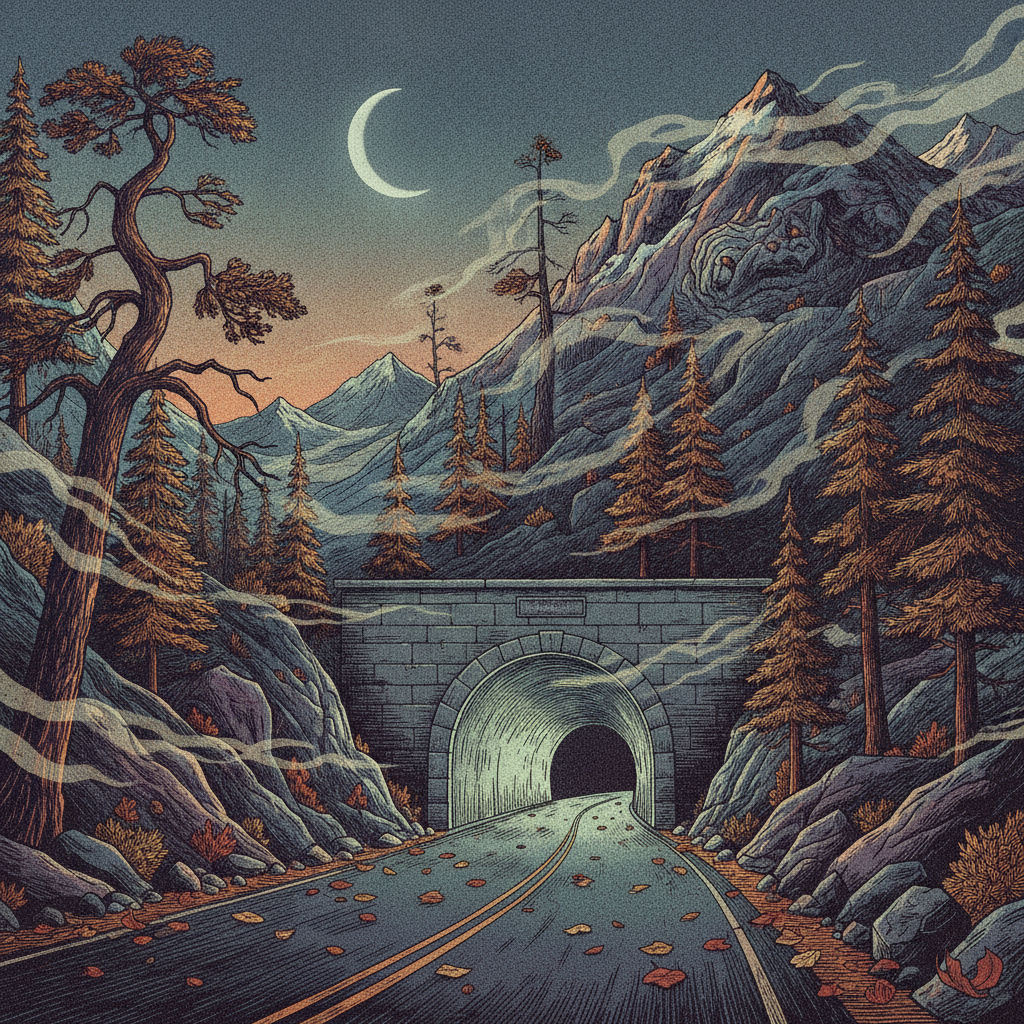
The wind through Loveland Pass carries a particular kind of cold — the kind that settles into your bones and makes the old mountain men swear the pass itself doesn’t want you crossing it. For decades, that wind was the only way over the Continental Divide on this stretch of Colorado, until engineers decided to go through the mountain instead of over it. What they built became one of the great engineering achievements of the American highway system. It also became, in the decades since, one of Colorado’s most persistent urban legends.
The Eisenhower-Johnson Memorial Tunnel carries Interstate 70 nearly 1.7 miles through the belly of the Rockies, and if you’ve driven it at night, alone, watching the sodium lights strobe against your windshield in that hypnotic rhythm, you understand instinctively why stories cling to this place. Drivers and truckers have spoken for years of phantom knocking on their vehicles from outside, radios dissolving into static and garbled voices, and glimpses of shadowy figures standing motionless along the tunnel walls — figures that vanish before a second glance confirms them. This is the story of where that legend came from, and what actually happened beneath the Divide to give it such staying power.
A Decade Spent Fighting the Mountain
Construction on the tunnel began in 1968 and didn’t finish until 1979 — an eleven-year undertaking that reflects just how difficult it was to bore through solid granite at over 11,000 feet of elevation. The westbound bore opened to traffic in 1973, named for President Dwight D. Eisenhower, whose vision for the interstate highway system made the project possible. The eastbound bore followed six years later, in 1979, and was named for Edwin C. Johnson, the former Colorado governor and U.S. senator who championed the highway route through the state.
According to Colorado Department of Transportation records and historical coverage of the project, the tunnel remains the highest vehicular tunnel in the world built through the Continental Divide, and at the time of its completion, one of the most significant engineering feats in American highway history. Crews faced unstable rock, fault zones, groundwater intrusion, and the sheer physical toll of working at extreme altitude — conditions that made the project both slower and more dangerous than initially anticipated.
Documented histories of the tunnel’s construction acknowledge that workers were killed during the project’s decade-long timeline, casualties of a job that required blasting and shoring up a passage through some of the most geologically unstable terrain in the state. Tunneling projects of this scale and era — comparable to other major mountain bores across the American West — routinely carried fatal risk, and the Eisenhower-Johnson Tunnel was no exception. The exact toll varies depending on the source and how fatalities were categorized, but the throughline in the historical record is consistent: real men died building the passage that millions of drivers now use every year without a second thought.
That fact — sober, well-documented, and easy to forget while you’re checking your gas gauge and merging toward the eastbound bore — is the seed from which Colorado’s tunnel legend grew.
The Legend Beneath the Lights
Ask around at a truck stop near Silverthorne or Georgetown, and you’ll likely hear some version of the same story, passed hand to hand across years of long-haul drivers and mountain commuters. The tale generally goes like this: something is off inside the tunnel. CB radios crackle into unintelligible noise partway through the passage. Drivers report a knocking sound against their car doors or truck panels — sharp, deliberate, impossible given there’s nowhere for anyone to be standing outside a moving vehicle in a two-lane bore. Others describe glancing toward the tunnel’s service alcoves or maintenance nooks and seeing a figure that shouldn’t be there, gone by the time their eyes adjust.
There is no single verified incident report, no newspaper investigation with named witnesses, that anchors this legend to a specific date or driver. It exists the way most great American road legends exist — as folklore accumulated over decades of repetition, evolving slightly with each telling, attached loosely to a real place with a real, tragic history. That’s precisely what makes it durable. The Eisenhower Tunnel legend isn’t built on nothing; it’s built on the uncomfortable, true fact that people died carving this passage through the mountain, and something about human nature insists that such places remember.
Colorado has no shortage of company here. The state’s folklore landscape is dense with reputedly haunted ground — from Denver’s Molly Brown House to the notorious “Bermuda Triangle of the West” stretching across the San Luis Valley, a region long associated with UFO sightings and unexplained phenomena, as Colorado Gazette reporting has explored. Colorado Public Radio has even put out a public call asking residents to share their own ghost stories, urban legends, and strange tales from around the state — a reminder that this kind of folklore is very much alive and actively being collected, not just archived history.
Why the Story Won’t Let Go
Part of what keeps the Eisenhower Tunnel legend circulating is simple physics dressed up as the supernatural. Radio interference inside long mountain tunnels is a well-documented, mundane phenomenon — solid rock and depth disrupt signal in ways that can produce exactly the kind of static and garbled audio drivers describe. The tunnel’s own maintenance infrastructure, ventilation systems, and structural expansion joints can produce unexpected sounds that travel strangely in an enclosed, echoing space. None of this requires a ghost.
But knowing the mundane explanation rarely defuses a good legend — if anything, it coexists comfortably alongside it. Drivers who’ve felt the specific unease of crossing 1.7 miles of mountain in total isolation, sealed inside artificial light with thousands of feet of granite pressing down overhead, understand that the feeling itself needs no scientific footnote. The tunnel is disorienting by design. Add a documented history of worker fatalities, and the human imagination does the rest.
Fact, Folklore, and the Space Between
What can be said with confidence: the Eisenhower-Johnson Memorial Tunnel was an eleven-year, extraordinarily difficult construction project that claimed workers’ lives in the process of connecting Colorado’s high country to the interstate system. What remains firmly in the territory of folklore: the phantom knocking, the vanishing figures, the sense that something rides along in the dark with you on the eastbound climb.
Nothing about the ghost stories has been formally investigated or documented in the way the tunnel’s engineering and construction history has. There’s no paper trail of named witnesses or official incident reports — only the informal, word-of-mouth tradition that treats the tunnel as one of the state’s great unexplained road mysteries. That doesn’t make the stories worthless. It makes them exactly what they are: an evergreen piece of Colorado folklore, rooted in a real and somber history, still being told every time headlights disappear into that mountain and don’t come out the other side quite as fast as the driver expected.
Next time you make the drive — Denver to Summit County, ski trip or otherwise — take a moment as you enter that dark. Somewhere beneath 11,000 feet of solid rock, real men once fought the mountain and lost. Whatever you hear on the way through, that much, at least, is true.