
Mountain Lion in the Suburbs: Denver's Real Urban Legend
A mountain lion lounging in a Denver suburb shut down a road—and revived old legends about wild things crossing into the city at the edges of dusk.
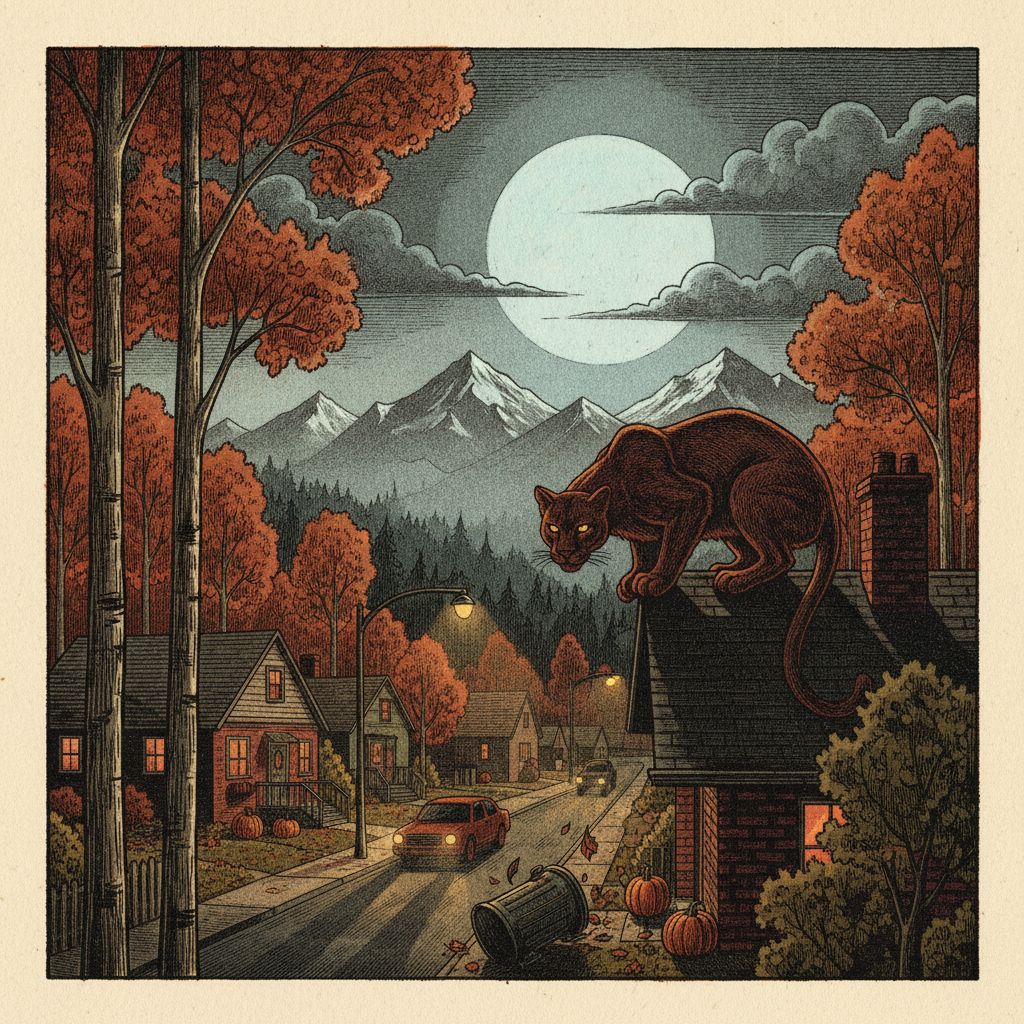
The call came in like something out of a Front Range chain email: a mountain lion, apparently unbothered by the trappings of suburbia, had settled down for a rest in a residential area near Denver. According to the Denver Gazette’s September 15, 2026 report, the big cat’s presence was enough to prompt a full road closure as authorities worked to keep residents—and the animal—safe until it could move on of its own accord. No one was hurt. No tranquilizer darts, no dramatic chase. Just a cougar, lounging, while a city block held its breath.
It’s a mundane kind of strange that Coloradans have come to know well. And it’s exactly the kind of incident that, retold at a dinner party or shared a hundred times on social media, starts to curdle into something bigger than itself—something closer to legend.
A Confirmed Encounter, Not a Cryptid
Let’s be clear about what happened near Denver: this was a real, documented wildlife event, not a paranormal one. Mountain lions—also called cougars, pumas, or catamounts depending on which old-timer you’re talking to—are native, protected predators in Colorado, and their range has never actually receded from the urban edge the way most residents assume. Colorado Parks and Wildlife (CPW) maintains ongoing public information and reporting systems specifically because human-mountain lion contact, while still rare, is a known and managed feature of life along the Front Range, not an aberration.
CPW’s guidance exists precisely because incidents like the one that shut down that residential road aren’t isolated. The agency routinely reminds residents in foothill communities—Boulder, Golden, Evergreen, the western fringes of Colorado Springs—that mountain lions pass through, den near, and occasionally nap in neighborhoods built atop what used to be, and in many ways still is, their territory. A sleeping cougar on a cul-de-sac isn’t an omen. It’s a Tuesday.
And yet.
The Phantom Cougar of the Foothills
Colorado has a long folk tradition of treating wild predators at the urban fringe as something more than wildlife management footnotes. Call it the phantom cougar phenomenon: the sense, passed down through generations of foothill residents, that something old and untamed is always just at the edge of the porch light, watching.
This isn’t unique to Colorado—cougar folklore runs through the entire American West, often tangled up with stories of “ghost cats,” black panthers that supposedly haunt specific canyons or ranch roads, and big cats said to appear right before bad luck strikes a household. Colorado’s version tends to be quieter and more domestic in scale: the shape at the tree line that vanishes when you look directly at it, the paw prints in snow that lead nowhere, the certainty among old ranching families that a particular gulch or mesa has always had “a lion in it,” generation after generation, as though the animal itself were eternal rather than simply doing what mountain lions do—existing, undetected, most of the time.
What’s notable is how quickly a confirmed, mundane sighting gets folded into that older narrative tradition. A mountain lion lounging on a residential street becomes, in the retelling, a mountain lion that was “waiting” for something, or “watching” the house, or had been “seen before, years ago, in that exact spot.” None of that reframing is malicious. It’s just how oral tradition works in a state where the wilderness and the subdivision share a fence line.
Why We Mythologize the Mundane
There’s a reason Coloradans are primed to treat a cougar sighting as near-mythic rather than simply biological. Front Range communities occupy a strange liminal zone—genuinely urban in infrastructure, genuinely wild in ecology. Denver’s suburbs press directly against foothills that are still home to black bears, mountain lions, elk, and the occasional moose wandering in from higher country. That proximity creates a cultural ache: a low hum of awareness that the built environment is thinner than it looks, that something wilder could cross into the cul-de-sac at any moment.
This same September, a bear made headlines after stealing a gear bag from a fire department in another Colorado city, according to the Denver Gazette—a story that got passed around for its charm as much as its strangeness. These stories work on us the same way ghost stories do: they remind us that control over our environment is provisional, that something older than the street grid is still operating just beyond the window.
It’s worth noting that Colorado’s appetite for the unexplained isn’t limited to wildlife. The same news cycle that carried the mountain lion story also included fresh federal UAP document releases tied to sightings over Colorado Springs, reported by Denver7 and the Colorado Springs Gazette, plus continued attention on a declassified CIA report describing a frightening UFO encounter in Colorado, according to the Denver Gazette. Colorado Public Radio has even put out a public call asking residents to share their own ghost stories and strange tales. There’s a throughline here: a state whose landscape and history make it unusually fertile ground for turning the unexplained—or even the simply unusual—into folklore.
Where Fact Ends and Legend Begins
The mountain lion that closed a Denver-area road will likely be forgotten as hard news within a news cycle or two. But stories like it have a way of persisting in a different form—told at trailheads, repeated by neighbors, eventually detached from the original report entirely. That’s not a flaw in how Coloradans process these encounters; it’s a feature of living somewhere the wild and the developed overlap so completely that a cougar on a residential street feels, at once, like the most natural thing in the world and like a visitation.
Colorado Parks and Wildlife will keep logging these encounters as what they are: documented, manageable wildlife activity in a region where that activity never really stopped. But somewhere down the line, in someone’s retelling around a campfire or a backyard firepit, that lounging mountain lion will have been “watching” the house for days before anyone noticed. That’s the real urban legend of the Front Range—not a ghost, not a cryptid, but the quiet, persistent memory that the mountains never actually let go of the land we built on top of them.