
The 1975 Cattle Mutilation Panic That Brought the FBI to Colorado
Decades before 'cattle mutilation' became a punchline, a real 1975 wave of unexplained deaths in Colorado triggered a formal FBI investigation.
A Strange Harvest on the High Plains
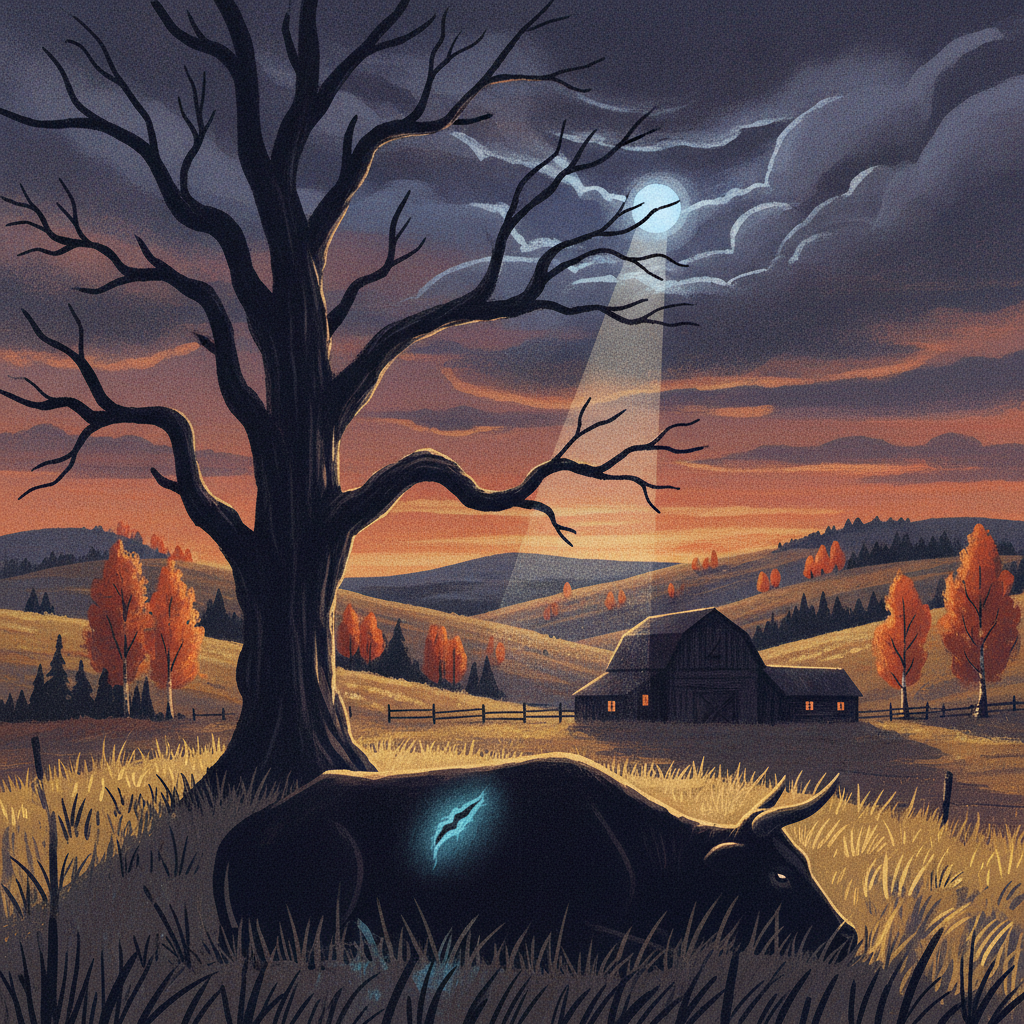
In the spring of 1975, ranchers across northeastern Colorado began finding their cattle dead in ways that defied easy explanation. The animals were discovered in open pastures, often with no tracks leading to or from the carcasses, no signs of struggle, and no blood pooled on the ground. Soft tissue — eyes, tongues, udders, reproductive organs — had been removed with what witnesses and investigating officers described as startling precision. Some ranchers and local deputies likened the wounds to surgical incisions rather than the ragged tearing expected from predators or scavengers.
This wasn’t Colorado’s first brush with the phenomenon. The case of “Snippy” (also known as Lady), a horse found dead and mutilated near Alamosa in the San Luis Valley in September 1967, had already become a touchstone of American paranormal folklore, drawing national press attention and early UFO speculation. But the 1975 wave was different in scale. Reports poured in from ranches across Logan, Washington, Kit Carson, Pueblo, and other counties, and by that summer, local law enforcement agencies — accustomed to coyote kills and the occasional poaching case — found themselves overwhelmed by a pattern of deaths they could not readily categorize using conventional forensics.
A Senator Steps In
The panic grew significant enough that it reached the desk of U.S. Senator Floyd Haskell, a Colorado Democrat. Alarmed by the volume of reports and the apparent helplessness of local and state agencies to explain what was happening, Haskell formally requested that the FBI investigate the mutilations, citing concern that ranchers were suffering real economic losses and that no agency had the resources or jurisdiction to coordinate a response across county lines. His request elevated what had been a regional rural mystery into a matter of federal interest — a remarkable step for an agricultural anomaly, and one that underscored just how seriously the phenomenon was being taken at the time, not merely by tabloids, but by elected officials responsible for representing ranching communities.
The FBI’s involvement, prompted in part by Haskell’s request, marked one of the only times the mutilation phenomenon received this kind of formal federal attention. It also cemented 1975 as a watershed year in American paranormal history — the moment “cattle mutilation” stopped being a strange regional story out of the San Luis Valley and became a multi-state phenomenon discussed in Congress, covered by wire services, and investigated, however briefly, by the nation’s premier law enforcement agency.
What Ranchers and Deputies Reported
Period news coverage from 1975 painted a picture of genuine confusion among the people closest to the carcasses. Ranchers described finding animals that had seemingly dropped where they stood, with surrounding grass undisturbed. Local sheriffs, veterinarians, and brand inspectors who examined the bodies often disagreed on causes — some concluded the wounds were consistent with predation and natural decomposition, in which bloating and skin-splitting can create the illusion of clean removal; others insisted the cuts were too precise, too bloodless, and too selectively placed on organs to be the work of coyotes, birds, or insects.
This disagreement between professionals is itself one of the most documented and genuinely strange elements of the case. It wasn’t fringe researchers alone claiming something anomalous was happening — it was working cattlemen and the law enforcement officers called out to their land, people with every incentive to find a mundane explanation and move on, who in many cases could not reconcile what they saw with ordinary animal death.
Theories: Predators, Cults, the Military, and the Sky
As the body count rose through 1975, so did the number of competing explanations, each reflecting the anxieties of the era:
Predators and natural decomposition. The most conventional explanation held that opportunistic scavengers — coyotes, magpies, insects — combined with the natural process of bloat and skin-splitting to produce wounds that only appeared surgical. Soft, blood-rich tissues like lips, eyes, and genitals are often the first areas scavengers target, and decomposition gasses can cause skin to separate along lines that look deliberately cut.
Cult or occult activity. Given the era’s broader cultural anxieties about satanic cults and ritual crime — fears that would later crest in the “Satanic Panic” of the 1980s — some investigators and members of the public speculated that the mutilations were the work of secretive ritualistic groups harvesting organs for ceremonial purposes. No prosecutable evidence of cult involvement was ever produced in connection with the Colorado cases.
Covert government or military testing. Given Colorado’s dense concentration of defense infrastructure — from NORAD under Cheyenne Mountain to various military testing grounds across the plains — many ranchers and residents suspected clandestine government experimentation, possibly involving chemical or biological agents, with the mutilations representing collateral damage from classified programs. This theory was fueled by the unmarked helicopters some witnesses reported seeing in the vicinity of mutilation sites, a detail that recurred in mutilation reports across multiple western states during the 1970s.
Extraterrestrial involvement. Then, as now, UFO researchers pointed to the precision of the wounds, the absence of tracks or blood, and the reports of unusual aircraft as evidence that something not of this world was responsible — perhaps biological sampling conducted by non-human visitors. This theory found a receptive audience in a decade already saturated with UFO reports nationwide, and it remains the explanation most associated with the phenomenon in popular memory, even though it was never substantiated by physical evidence collected at any Colorado site.
What the Investigation Found — and What It Didn’t
The FBI’s inquiry, prompted by Haskell’s request, did not produce evidence of criminal activity, cult involvement, or extraterrestrial contact. In the years following the 1975 wave, a more formal scientific review — a federally funded study conducted under a Law Enforcement Assistance Administration grant and led by retired FBI agent Kenneth Rommel in the late 1970s, focused primarily on a parallel wave of mutilations in New Mexico — concluded that the overwhelming majority of examined cases were consistent with predation and natural decomposition rather than human or anomalous intervention.
That conclusion satisfied some observers and infuriated others, particularly ranchers who had seen the carcasses firsthand and felt that no laboratory report could account for what they witnessed in the field. The gap between official explanation and eyewitness conviction has never fully closed, and it remains the defining tension of the entire mutilation phenomenon: a documented, federally acknowledged wave of unexplained animal deaths, met with an official conclusion that satisfies the paperwork but not the people who lived through it.
A Mystery That Still Echoes
Fifty years later, Colorado remains a place where the line between official skepticism and public suspicion about the unexplained stays remarkably thin. The state has seen a fresh wave of declassified UFO and UAP files in recent years, including newly released documents describing sightings over Colorado Springs and a Pentagon program examining unexplained aerial phenomena — a reminder that the appetite for answers about the unknown skies over Colorado has never really faded. The 1975 cattle mutilation panic may be a product of its own anxious decade, but it endures because it was never neatly solved. A U.S. senator asked the FBI to look into it. The FBI did. And ranchers in Logan and Washington counties were left, much like paranormal investigators today, with more documented questions than answers.