
The Liberty Bell Avalanche: Telluride's Deadliest Disaster
A 1902 avalanche buried Telluride miners alive in their bunkhouse—the true story behind one of Colorado's deadliest mining disasters.
A Mountain That Swallowed a Bunkhouse
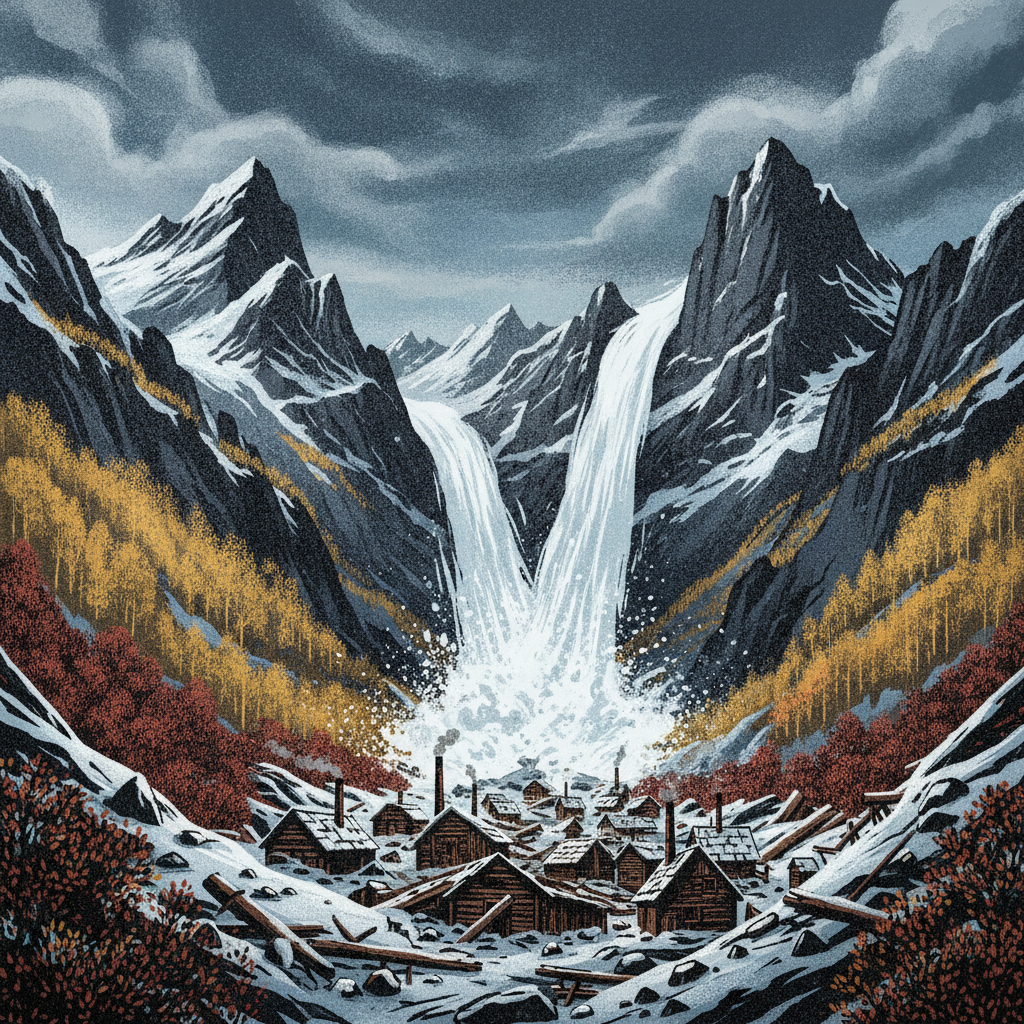
High above Telluride, where the San Juan Mountains fold into some of the steepest and most avalanche-prone terrain in North America, the snow doesn’t just fall — it waits. In the winter of 1902, it struck with a force that erased an entire bunkhouse full of sleeping men in seconds, leaving behind one of the deadliest single disasters in Colorado mining history.
The Liberty Bell Mine sat in a basin above Telluride at an elevation where winter arrives early and leaves late, and where the slopes above the mine workings funnel snow into chutes capable of generating catastrophic slides. On the night of March 18, 1902, one of those slides came down on the mine’s boardinghouse, where miners were sleeping after their shifts. The avalanche destroyed the structure and buried workers where they lay. Historical accounts of the disaster, preserved in San Miguel County records and regional mining histories, put the death toll at nineteen or more, making it among the deadliest avalanche events tied to Colorado’s hard-rock mining era.
Life and Death in the High Basins
To understand why disasters like Liberty Bell happened, you have to understand where — and how — Colorado’s mining companies built their operations. The San Juan Mountains were rich in silver and gold, but the ore didn’t care about elevation or weather. Mines like Liberty Bell, Smuggler-Union, and Tomboy were carved into basins well above 11,000 feet, terrain chosen for its mineral veins, not its safety from the elements.
Boardinghouses and bunkhouses were often built directly in or near avalanche paths because there simply wasn’t flat, stable ground elsewhere. Miners worked brutal shifts in freezing conditions, then slept in structures perched beneath slopes that, after a heavy snow year, could unleash tens of thousands of tons of snow with almost no warning. The Liberty Bell disaster wasn’t a freak occurrence — it was part of a grim pattern. Avalanches killed miners throughout the district across multiple winters, and the Telluride region as a whole recorded repeated slide fatalities in the early 1900s as mining companies pushed operations ever higher into the mountains in pursuit of ore.
This was also the era of the Western Federation of Miners, the militant labor union that organized hard-rock miners across Colorado’s mining camps, including Telluride. The WFM had already clashed violently with mine owners in the district during labor disputes in the years surrounding the Liberty Bell disaster, and safety conditions — or the lack of them — were a persistent grievance. Avalanche danger was simply one more hazard layered onto a job that already included cave-ins, dynamite accidents, silicosis from rock dust, and brutal cold. Miners understood the risk of the basins they worked in, but economic necessity, and company decisions about where to house workers, left them with little choice but to sleep beneath the slopes.
The Night of March 18
Details of the exact sequence of the Liberty Bell slide are limited to what survived in period records, but the broad outline is well documented: a heavy snow season had loaded the slopes above the mine, and conditions were primed for release. When the slide came, it hit the boardinghouse with enough force to demolish it, burying men under snow, timber, and debris in the dark. Rescue efforts in these disasters were always a race against suffocation and cold, complicated by the same unstable snowpack that caused the initial slide — rescuers risked triggering secondary avalanches as they dug for survivors and recovered the dead.
The death toll from Liberty Bell stands among the highest recorded from a single avalanche event in Colorado mining history, and it remains a benchmark case study for understanding the risks that defined high-altitude mining in the San Juans. Mining disaster archives and Colorado historical societies continue to cite it as one of the signature tragedies of the Telluride district’s silver boom years.
A Pattern Written in Snow
What makes Liberty Bell particularly haunting from a historical standpoint is that it wasn’t isolated. The same basin and surrounding terrain produced other deadly slides in the following decades, and the broader Telluride mining district saw repeated avalanche fatalities as operations continued at Tomboy, Smuggler-Union, and other high-elevation properties. Geologists and avalanche researchers who study the San Juan Mountains today point to the region’s combination of steep, wind-loaded slopes, persistent weak layers in the snowpack, and heavy winter storm cycles as a recipe for exactly the kind of catastrophic slab avalanches that struck Liberty Bell. The terrain hasn’t changed — only the fact that no one builds bunkhouses in the chutes anymore.
Ghost Town Lore in the Basin
Telluride today is known as much for its ski slopes and film festival as its mining past, but the ruins scattered through Liberty Bell Basin and the surrounding high country have long been part of Colorado’s ghost-town storytelling tradition. Local lore — and it’s important to be clear that this is folklore, not documented history — holds that the basin carries a heaviness, that hikers and backcountry skiers passing old foundation stones and collapsed timber report an inexplicable unease, or the sense of being watched near where the boardinghouse once stood.
These stories fit into a broader pattern found across Colorado’s old mining camps, from Central City to Cripple Creek to St. Elmo, where sites of historic tragedy accumulate ghost stories over generations. There’s no documented paranormal investigation or verified sighting on record tied specifically to Liberty Bell Basin — unlike, say, recently publicized paranormal investigations of historic Denver buildings that have drawn television crews and formal investigators. What exists at Liberty Bell is simply the oral tradition common to disaster sites: a basin where something terrible happened, retold by locals and hikers, absorbed into the regional mythology of a mountain town built on top of its own graveyard.
What Remains
The Liberty Bell Mine itself continued operating for years after the 1902 disaster, as did most of the mines in the district — the economics of silver and gold meant companies rarely abandoned productive ground because of loss of life, a hard truth of the era’s labor conditions. Today, remnants of mining infrastructure still dot the high basins above Telluride, visible to hikers and backcountry travelers who venture into the terrain during the summer months when the avalanche danger that killed nineteen men in 1902 is, for a few months, dormant.
The Liberty Bell avalanche deserves to be remembered not as a ghost story first, but as a labor and mining history story — a window into what it cost, in human lives, to pull silver and gold out of some of the most unforgiving terrain in Colorado. The folklore that’s grown up around the basin in the century since is a natural outgrowth of that history, Colorado’s way of keeping the memory of the dead present in a landscape that otherwise shows little trace of what happened there. But the documented facts alone — a boardinghouse, a sleeping shift of miners, a mountain that let go in the dark — need no embellishment to be among the most sobering chapters in Colorado’s mining history.