
The Smuggler-Union Fire: Telluride's Deadliest Night Underground
In 1901, smoke filled the Smuggler-Union Mine above Telluride, killing two dozen miners. The disaster still haunts Colorado's high country.
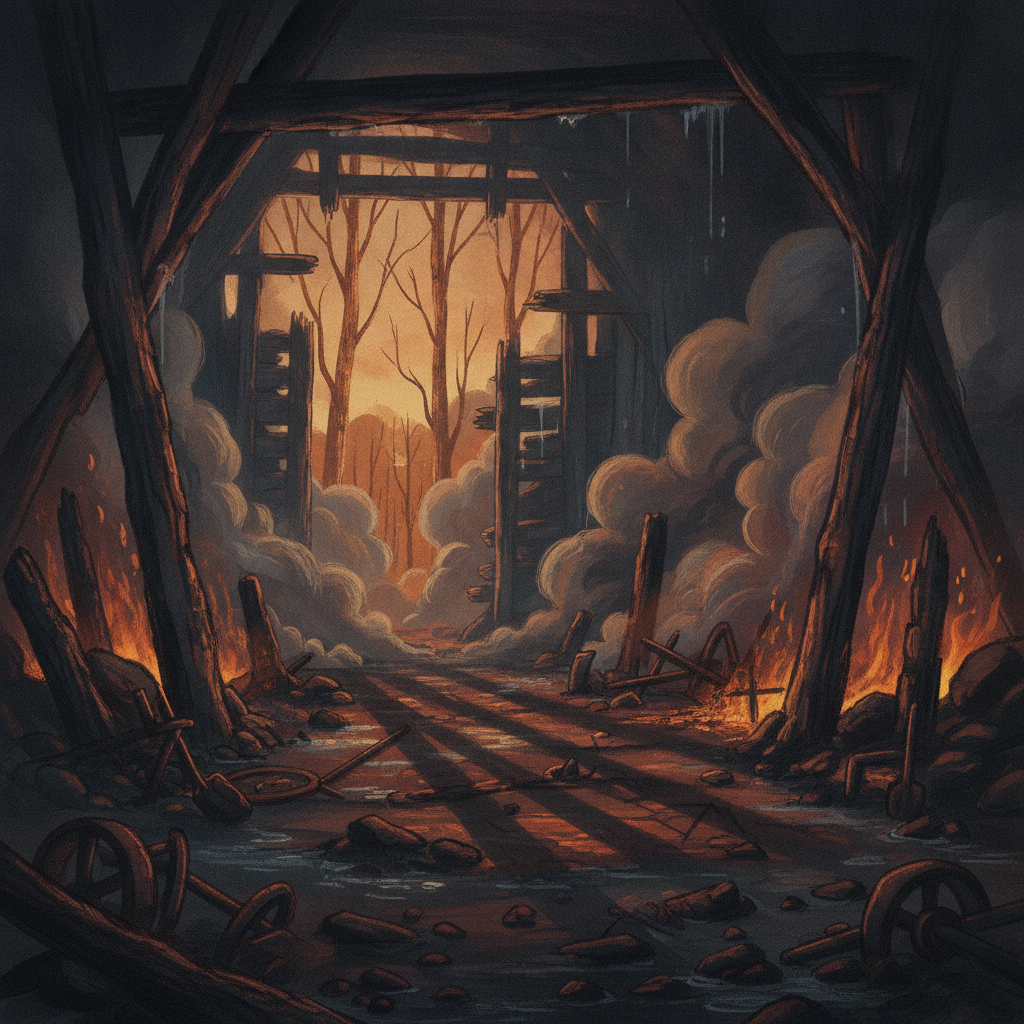
The fire started small, the way most underground disasters do. A spark, a smolder in old timber, a curl of smoke drifting through a drift that had been driven deep into the mountainside above Telluride. By the time anyone on the surface understood what was happening on the night of November 20, 1901, the Smuggler-Union Mine had already become a tomb for nearly two dozen men.
More than a century later, the disaster remains one of the deadliest single incidents in Colorado’s brutal hard-rock mining history — and one that unfolded against a backdrop of labor violence, corporate suspicion, and high-altitude isolation that still colors the way people talk about the old mine workings above the San Juan Mountains.
A Mine Built on Timber and Altitude
The Smuggler-Union was not just another claim scratched into the San Juans. By the turn of the twentieth century it was one of the richest gold producers in Colorado, a sprawling underground complex connected by miles of tunnels running through Marshall Basin and Savage Basin, high above Telluride, with ore hauled down through tramways and tunnels to the mill at Pandora. Like nearly every hard-rock mine of the era, its workings depended on timber — heavy wooden sets shoring up tunnels blasted through rock that would otherwise collapse under its own weight.
That dependence on wood was also the mine’s great vulnerability. Underground fires in timbered mines were a known and feared hazard across Colorado’s mining districts; timber burned hot and slow, choking tunnels with smoke long before flame became visible, and ventilation systems built to move fresh air could just as easily pull poisonous smoke and gas deeper into the workings instead of clearing them out.
That is what historical accounts indicate happened at the Smuggler-Union on the night of the fire. A blaze broke out in the timbering deep within the mine’s tunnel system. Rather than staying contained, smoke spread rapidly through the interconnected drifts, filling passageways with air that miners could not breathe. Men working far from the fire itself — in sections of the mine that may have seemed entirely safe — were caught by smoke and gas with little warning and little chance to reach the surface.
The Night of the Fire
Mining disaster records and Colorado mining histories describe a scene of chaos and desperation as word of the fire reached the surface and rescue parties began descending into the smoke-filled tunnels. Rescue efforts in hard-rock mines of this era were primitive by modern standards — no self-contained breathing apparatus, no thermal imaging, often little more than wet cloths over the face and the hope that fresh air could be pushed ahead of the rescuers fast enough to matter.
The recovery operation that followed was grim and prolonged. Bodies were found scattered through the workings, some miners having nearly reached safety before being overcome, others seemingly trapped where they had been working when the smoke arrived. Historical tallies of the dead vary somewhat between sources, with figures commonly cited in the range of roughly two dozen men, some records placing the toll as high as the upper twenties — a reflection of how difficult it was, even afterward, to get a precise accounting of who had been underground and where.
The Smuggler-Union fire took its place alongside other major Colorado mining disasters of the period — explosions, cave-ins, and fires that killed miners from Cripple Creek to Leadville to the coal fields near Trinidad — as grim evidence of just how dangerous hard-rock and coal mining remained even as Colorado’s extraction industries generated enormous wealth for mine owners and investors.
A District Already on Edge
The fire did not occur in a vacuum. Telluride’s mining district in 1901 was a tense place. Earlier that year, the Smuggler-Union had been the site of a violent labor strike as miners — organized through the San Miguel Miners’ Union, a local of the Western Federation of Miners, with Vincent St. John among the union’s prominent organizers in the district — clashed with management over pay structures and working conditions. The strike turned deadly that summer, with gunfire exchanged between strikers and strikebreakers brought in to keep the mine operating, and mine general manager Arthur Collins became a central, polarizing figure in the standoff.
Only months after that violence was resolved, the fire swept through the same mine’s tunnels. The disaster added another layer of grief and distrust to a workforce that had already spent the year locked in conflict with ownership over how the mine was run and how its men were treated. The broader Telluride mining district would remain a flashpoint for labor conflict in the years that followed — Collins himself was assassinated by a sniper’s bullet through his office window in November 1902, a killing never definitively solved, and the district erupted again during the Colorado Labor Wars of 1903–04, when the Western Federation of Miners clashed with mine owners and the state militia across the San Juans.
The Smuggler-Union fire sits at the intersection of these threads: the raw physical danger of hard-rock mining at 12,000 feet, and the human cost of an industry where safety often came second to production.
Legends in the High Country
Given this history, it’s little surprise that the ruins scattered through the Telluride mining district — collapsed portals, rusted machinery, the scattered remains of boardinghouses and mill foundations above timberline — have accumulated their share of ghost stories over the decades. Colorado’s abandoned mining camps and mine sites are frequent subjects of local folklore, and the San Juan Mountains, with their brutal winters, isolation, and long history of fatal accidents, are no exception.
Local legend around Telluride and similar high-altitude mining ruins sometimes speaks of lingering presences at old mine openings, unexplained sounds carried on mountain wind, or a sense of being watched near collapsed tunnel entrances. These stories should be understood clearly as folklore and oral tradition rather than documented phenomena — there is no verified paranormal record tied specifically to the Smuggler-Union fire itself. What is verifiable is the human tragedy: real men who went to work on an ordinary November night and did not come home, in a mine whose name is etched into Colorado’s mining archives for reasons far more concrete than any ghost story.
Remembering the Men Underground
More than a century on, the Smuggler-Union fire is easy to overlook next to Telluride’s modern identity as a ski resort and festival town. But the mine’s tunnels still honeycomb the mountains above the valley, silent reminders of an industry that built the town and nearly emptied it of life in equal measure. The disaster deserves to be remembered not as a ghost story, but as part of the real, hard history of the men who worked — and sometimes died — in the dark beneath Colorado’s most beautiful peaks.