
Butch Cassidy's First Heist: Telluride's Outlaw Legend
The true story of Butch Cassidy's 1889 Telluride bank robbery — his first major heist — and the outlaw lore that still haunts the mining town.
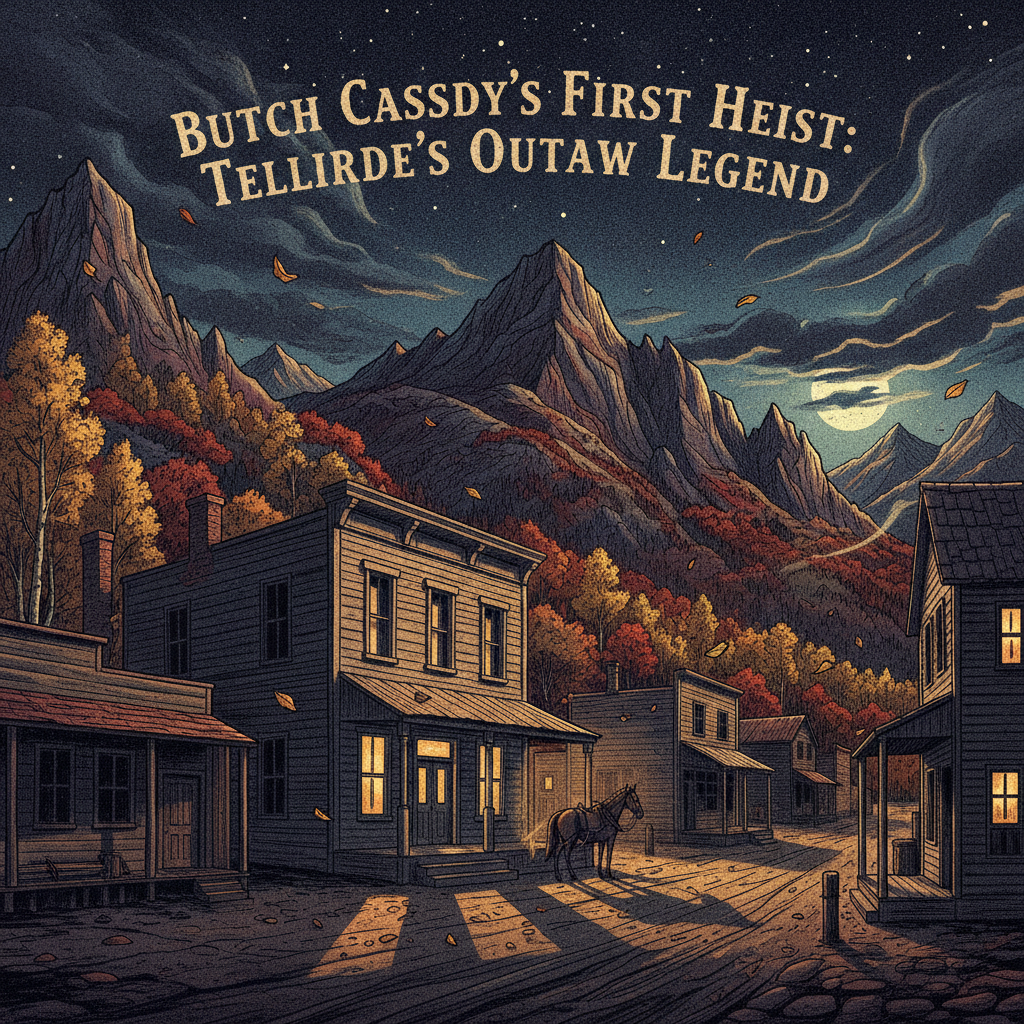
The San Miguel Valley Bank still stands on the corner of Colorado Avenue in Telluride, its brick facade largely unchanged since the 1880s. Tourists photograph it between gallery visits and coffee runs, rarely pausing to consider that this unassuming building marks the birthplace of one of the American West’s most enduring outlaw legends. On a June afternoon in 1889, a young cowhand named Robert LeRoy Parker walked through its doors and walked out a wanted man — the first step in a criminal career that would eventually make him famous under a different name: Butch Cassidy.
A Cowboy Turned Criminal
Before he was Butch Cassidy, Robert LeRoy Parker was, by most accounts, a hardworking and well-liked ranch hand. Historical records and accounts preserved by the Telluride Historical Museum indicate Parker spent time working at the Carlisle Ranch north of Telluride in the late 1880s, herding cattle and horses across the rugged San Miguel County terrain. It was honest work, and by several contemporary accounts, Parker was known locally as personable and capable — the kind of young man neighbors trusted, not one they suspected of plotting a bank job.
That familiarity with the landscape, however, would prove essential to what came next. Parker had learned the trails, the river crossings, and the high mountain passes surrounding Telluride — knowledge that would matter far more than any pistol once the robbery was done.
The Robbery
On June 24, 1889, Parker and a small group of accomplices — most commonly identified in historical accounts as Matt Warner and brothers Tom and (in some versions) Bill McCarty — rode into Telluride and robbed the San Miguel Valley Bank. Accounts of the exact haul vary somewhat between sources, but the figure most frequently cited in historical records and museum archives is around $10,500, a substantial sum for the era — equivalent to a small fortune by 1880s mining-town standards.
The robbery itself was reportedly executed with the calm efficiency that would later become a hallmark of Cassidy’s operations: in and out quickly, minimal violence, and a getaway plan built well in advance. This wasn’t the work of desperate amateurs — it had the markings of a crew that understood both the bank’s routine and the terrain they’d need to disappear into.
The Getaway
What happened in the hours after the robbery is where documented fact and local legend begin to intertwine most closely. According to accounts that have been passed down through regional histories and museum records, the gang’s escape relied on a relay system of fresh horses staged along their route — allowing them to outpace any posse riding on tired mounts. Their path is generally described as leading out of Telluride through the rugged country toward Utah, into the canyon lands and high desert that would later become familiar refuges for Cassidy and his associates, including the infamous Robbers Roost.
This use of pre-positioned horses is one of the details that historians point to as evidence of real planning — not the spontaneous act of a cowboy gone rogue, but a calculated operation. It’s also the detail outlaw lore loves most, because it paints Parker not as a common thief but as a strategist, already thinking several steps ahead of the law.
Pinkerton National Detective Agency records, which later tracked Cassidy extensively as his criminal career expanded through the 1890s, reflect how seriously law enforcement came to regard him in the years following Telluride. The agency’s files on Cassidy — built up over more than a decade — remain among the most cited primary sources for historians piecing together his movements, aliases, and known associates.
Becoming “Butch Cassidy”
The Telluride job predates the famous “Butch Cassidy” name and the Wild Bunch gang that would later make him a household outlaw name alongside Harry Longabaugh — the Sundance Kid. Historians generally regard the San Miguel Valley Bank robbery as Parker’s first major heist, the formative crime that set him on the path toward a career of train and bank robberies across Wyoming, Utah, and beyond. The “Cassidy” surname is widely believed to be an homage to Mike Cassidy, a rustler and mentor figure from Parker’s youth, while “Butch” came later, reportedly tied to a stint working as a butcher.
What’s notable to historians is how directly the Telluride robbery connects to everything that followed. The relay-horse escape tactic, the careful target selection, the reliance on a small trusted crew — these became signatures of Cassidy’s later, more famous jobs with the Wild Bunch.
Where Fact Gives Way to Folklore
Telluride has never let go of its outlaw son, and over more than a century, the documented history has accumulated a thick layer of legend. Local lore has long speculated that Cassidy — or members of his crew — buried a portion of the stolen money somewhere in the surrounding mountains, never recovered. No historical record confirms this; it exists purely as treasure-hunting folklore, the kind that tends to grow around any outlaw story involving cash and rugged, hideable terrain. Treasure hunters have periodically searched the backcountry around Telluride over the decades, though no verified discovery has ever been documented.
Other local tales suggest Cassidy returned to Telluride in later years under an assumed identity, quietly visiting the scene of his first crime as an old man. These stories persist in barroom conversation and ghost-tour scripts more than in verifiable record, and should be treated as exactly what they are: folklore, not history. Some paranormal enthusiasts and local tour operators have also tied residual “energy” or unexplained cold spots in the old bank building to the robbery’s legacy — claims that, like most Old West ghost lore, rest on atmosphere and storytelling tradition rather than documented evidence.
What can be said with confidence is this: the building is real, the robbery happened, the amount stolen is a matter of historical record (even if the exact figure varies slightly between sources), and the event genuinely launched one of the most mythologized criminal careers in American history. That’s a remarkable enough story without embellishment — though Telluride, like most mining towns with an outlaw in its past, has never been shy about embellishing anyway.
The Legend Endures
Today, the San Miguel Valley Bank building is a recognized piece of Telluride’s historical identity, and the robbery is commemorated in local museum exhibits and walking tours that trace Cassidy’s path through the town. It’s a rare case where documented true crime and romanticized Old West legend sit almost literally across the street from one another — the brick-and-mortar facts on one corner, the campfire stories on the next.
For a town built on mining fortunes and the boom-bust mythology of the Colorado frontier, it’s fitting that Telluride’s most famous outlaw story is also its most enduring one: a young ranch hand, a well-planned theft, a vanishing act into the high desert — and more than a century later, we’re still trying to separate the money he took from the myth he left behind.