
Castle Marne: Denver's Haunted Victorian Mansion on Race Street
Inside Castle Marne, a 19th-century Denver mansion turned inn where guests and owners have reported phantom piano music and ghostly visitors for decades.
A Castle Built from Rhyolite and Ambition
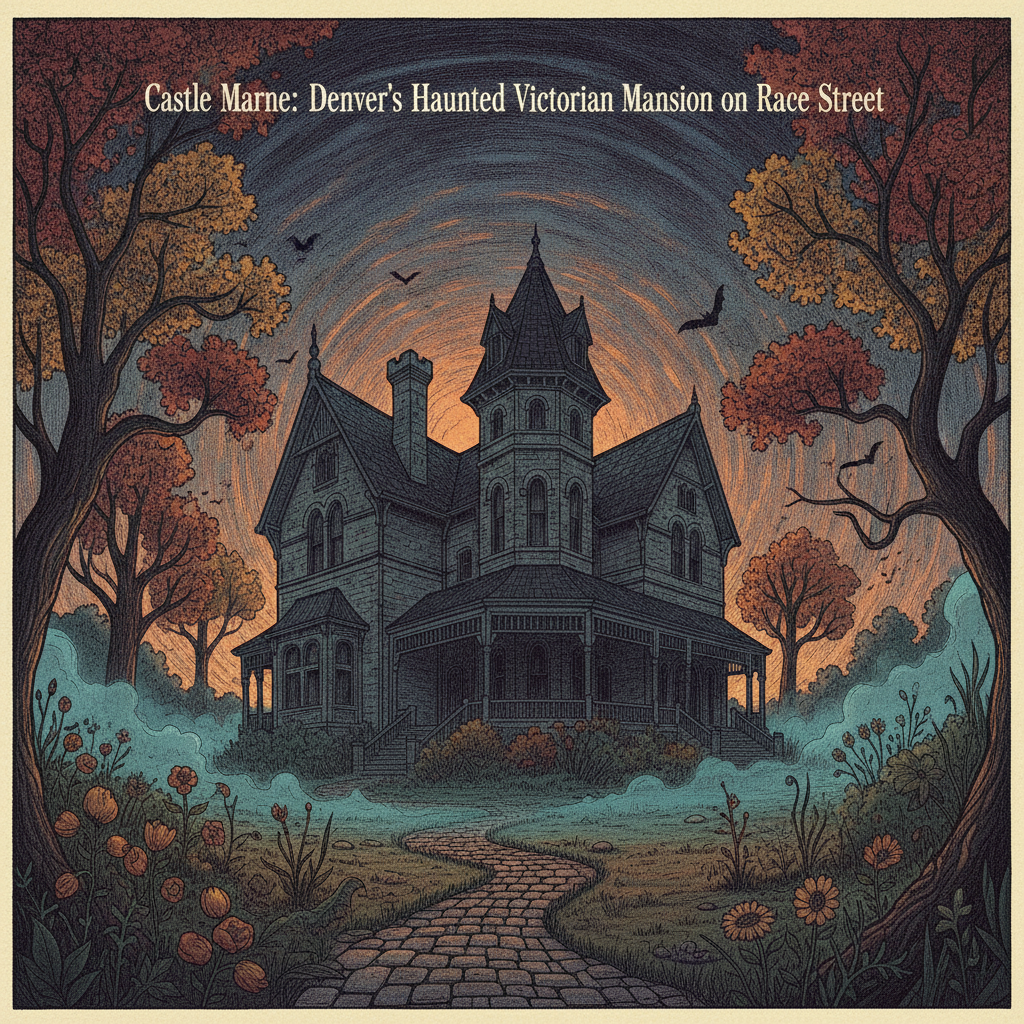
On the corner of 16th Avenue and Race Street in Denver’s Wyman Historic District stands a fortress of pink rhyolite stone, its turrets and gables rising against the Front Range skyline like something lifted from a Gothic novel. This is Castle Marne, built in 1889 by William Lang, the eccentric and prolific architect responsible for some of Denver’s most striking Victorian-era buildings, including the equally notorious Croke-Patterson Mansion on Pennsylvania Street.
Lang designed Castle Marne for William Lang Jr. and his clients with the kind of flamboyant detail that defined Denver’s gilded age — richly carved stonework, stained glass, and a round turret that has become the building’s signature silhouette. The mansion changed hands several times over the following century, surviving the city’s boom-and-bust cycles, a period of decline when much of the surrounding neighborhood fell into disrepair, and eventual restoration. By the late 20th century, the house had been reborn as the Melissa Marne House, a bed and breakfast that still operates today, inviting guests to sleep inside a piece of Denver’s architectural history.
It’s that long residential afterlife — generations of families, then decades of overnight guests — that gave Castle Marne its second reputation: as one of Denver’s most talked-about haunted addresses.
The Hauntings: Piano Music, Footsteps, and Cold Spots
Castle Marne’s ghost stories don’t come from a single dramatic event, but from something more unsettling in its own way — decades of small, repeated, hard-to-explain occurrences reported by people who lived in and operated the building.
According to Denver ghost-tour literature and local haunted-history guidebooks, the most persistent reports involve phantom piano music drifting through the house when no one is seated at the keys. Innkeepers and guests over the years have described hearing melodies from empty rooms, only to find the parlor silent and undisturbed upon investigation. Footsteps on the stairs and in upper hallways — heard when the house was supposedly empty — are another recurring theme in the property’s lore, along with sudden cold spots that visitors report moving through in specific rooms, often near the turret.
These accounts have circulated for decades through Denver’s ghost-tour circuit and local haunted-history writing, the same oral and published tradition that has kept stories of the city’s other “haunted Victorians” alive. As with most reputedly haunted buildings, there’s no scientific documentation of these phenomena — no recorded audio of the piano, no verified photographs of apparitions. What exists is a long, consistent thread of anecdotal testimony from different people across different eras, which is itself part of what makes a place like Castle Marne compelling to both skeptics and believers.
It’s worth being direct about the distinction here: the building, its architect, its construction date, and its history as a bed and breakfast are documented historical fact. The ghost stories are folklore — oral history passed down through innkeepers, guests, and Denver’s ghost-tour guides rather than claims verified by any investigative body. That doesn’t make them less interesting; it just means they belong in the category of local legend rather than established record, and readers should hold them that way.
Part of a Larger Denver Tradition
Castle Marne doesn’t haunt Denver’s imagination alone. It sits within a small constellation of Victorian-era mansions across the city that have accumulated similar reputations, each tied to the same architectural period and the same pattern of grand homes outliving their original families.
The Molly Brown House on Pennsylvania Street, former residence of Titanic survivor Margaret “Molly” Brown, is perhaps the city’s best-known haunted historic home, with volunteers and visitors over the years reporting the scent of cigar smoke or sensations of being watched in a house now operated as a museum. A few blocks away, the Croke-Patterson Mansion — another William Lang design — has carried a reputation for misfortune and unease among owners dating back generations, discussed extensively in Denver’s haunted-history guidebooks.
Castle Marne fits naturally into this lineage: a Lang-designed stone mansion, built in the same architectural moment, that transitioned from private residence to public-facing hospitality business, which exposed its interior — and its stories — to far more witnesses than a private home ever would. Bed and breakfasts are, in a sense, perfect incubators for ghost lore. Guests sleep in unfamiliar rooms, in old houses full of creaking wood and settling stone, primed by a building’s history to notice things they might otherwise dismiss. That doesn’t disprove anything reported at Castle Marne — it simply explains why old inns across the country, not just in Denver, tend to accumulate these kinds of stories.
Denver’s Haunted Houses in the Spotlight
Interest in Denver’s haunted mansions hasn’t faded with time — if anything, it’s found new audiences. Earlier this year, KDVR reported that a reputedly haunted Denver mansion had become available for lease, reigniting local conversation about the city’s haunted-property market. Colorado Public Radio has also put out a call for residents to share their own ghost stories, urban legends, and strange tales from around the state, a reminder that this kind of folklore is still actively being collected, not just preserved in old guidebooks.
Denver’s broader paranormal scene has stayed busy in other ways too. Paranormal investigators have recently explored a former Denver mortuary now operating as a restaurant, according to CBS News, and set their sights on venues like Ophelia’s Electric Soapbox for a television debut, per Denver7. Meanwhile, Colorado’s UFO history has resurfaced in the news as well, with declassified government files revealing additional sightings over Colorado Springs and even a report referenced on the CIA’s own website describing a “frightening” UFO encounter in the state. Whether the subject is a Victorian mansion or the skies above a 14,000-foot peak, Colorado’s relationship with the unexplained shows no sign of cooling.
Visiting Castle Marne Today
Castle Marne still operates as a bed and breakfast, welcoming overnight guests into the same rooms where decades of ghost stories have taken root. For visitors, that’s the real appeal: not a guarantee of a supernatural encounter, but the chance to spend a night inside a genuine piece of 1889 Denver architecture, surrounded by carved stone, stained glass, and more than a century of accumulated history — some of it documented, some of it only whispered.
Whether the piano music has a rational explanation — old pipes, settling wood, acoustics peculiar to a turret-shaped room — or something less easily accounted for, Castle Marne endures as one of Denver’s most atmospheric addresses. It stands as both a preserved architectural landmark and a living piece of the city’s ghost-story tradition, two identities that, in a place like Denver, have always been comfortable sharing the same roof.