Why the Pentagon Keeps Declassifying Colorado Springs UFOs
New federal files add more UAP sightings over Colorado Springs. A look at why this military-heavy city keeps turning up in declassified records.
A New Batch of Files, An Old Pattern
In early August 2026, two separate newsrooms pulled the same thread. Denver7 reported on a fresh release of government UFO files that included sightings over Colorado Springs, while the Colorado Springs Gazette detailed two newly declassified UAP (unidentified anomalous phenomena) encounters that took place above the city itself. Neither outlet described a single dramatic saucer-over-the-mountains moment — these were additions to the Pentagon’s slow, ongoing drip of declassified material, the kind of bureaucratic housekeeping that rarely makes headlines on its own. Except this is Colorado Springs, and that changes things.
For anyone who has tracked the UFO beat in Colorado for more than a few news cycles, the pattern is familiar. The city keeps showing up. Not Denver, not Pueblo, not the San Luis Valley with its decades of cattle mutilation lore — Colorado Springs, specifically, keeps surfacing in federal paperwork about things flying through American skies that nobody can quite identify.
This latest release follows a broader wave of Pentagon transparency efforts. CBS News reported in September 2026 that the Pentagon had released additional UFO files, including documents touching on a secretive military program — part of a slow expansion of what the Department of Defense’s All-domain Anomaly Resolution Office (AARO) has been willing to put on the public record since its creation in 2022. Even the CIA has gotten in on it: the Denver Gazette reported in May 2026 that the agency’s own website features a declassified account of a sighting in Colorado described in period documents as “frightening.” And in June 2026, the New York Times covered one of the stranger entries in recent files — a reported UAP sighting over Colorado so visually odd that witnesses described its shape as resembling a potato, a detail that made national headlines less for its menace than for its sheer absurdity.
Against that backdrop, the August 2026 Colorado Springs releases read less like an isolated anomaly and more like the latest entry in a file that’s been accumulating for seventy years.
A Skyline Built for Watching
To understand why Colorado Springs keeps generating sightings worth declassifying, it helps to look at what’s actually stationed there.
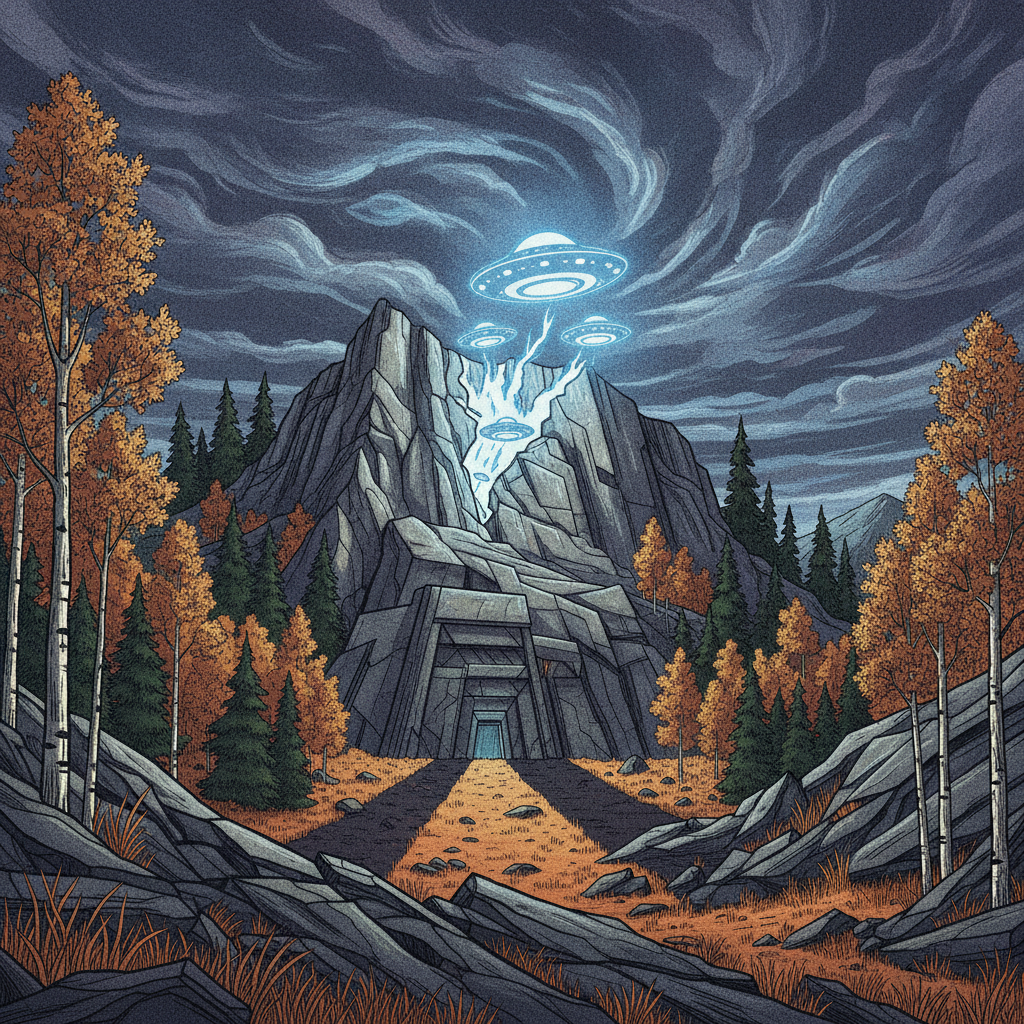
Peterson Space Force Base, on the city’s eastern edge, is the historic headquarters of North American Aerospace Defense Command (NORAD) — the joint U.S.-Canadian organization responsible for aerospace warning and control over the continent. A few miles away, Cheyenne Mountain Space Force Station sits inside a granite peak of the Rockies, built during the Cold War as a hardened command-and-control facility designed to survive a nuclear strike while continuing to track every object entering North American airspace. Schriever Space Force Base, east of the city, serves as a hub for satellite operations and space surveillance, home to units that monitor objects in orbit and support missile warning systems.
Put simply: this is one of the most heavily sensor-saturated patches of sky in the Western Hemisphere. Radar arrays, satellite tracking, restricted airspace, and a dense concentration of trained military observers all overlap here in a way that doesn’t exist over most American cities. When something strange crosses that airspace — a drone, a weather anomaly, a piece of experimental hardware, or something genuinely unidentified — there are simply more instruments and more witnesses positioned to notice it, and more institutional channels capable of generating a paper trail that eventually becomes a “file.”
That’s not proof of alien visitation. It’s geography and infrastructure. But it does help explain why Colorado Springs’ name keeps appearing in documents that other cities’ skies rarely produce.
From Blue Book to AARO
This isn’t a new phenomenon tied only to the current UAP disclosure push. Colorado’s entanglement with official UFO investigation goes back to the U.S. Air Force’s Project Blue Book, the program that from 1952 to 1969 catalogued and investigated thousands of reported sightings nationwide. When the Air Force wanted an independent scientific review of the UFO question in the late 1960s, it didn’t go to MIT or Caltech — it funded the University of Colorado UFO Project, commonly known as the Condon Committee, headquartered in Boulder and led by physicist Edward Condon. The committee’s 1968 final report concluded that further study was unlikely to yield much of scientific value, and Blue Book was shuttered the following year. Even then, Colorado was where the government chose to go looking for answers.
Decades later, the institutional apparatus has changed names and expanded its mandate, but the basic dynamic hasn’t: a concentration of military infrastructure in Colorado generates reports, and periodically, some of those reports get declassified. AARO’s recent releases — including the Colorado Springs sightings covered by Denver7 and the Gazette, and the broader September 2026 CBS News report on additional file releases — represent the modern continuation of a reporting pipeline that traces back to Blue Book’s investigators filling out forms at Air Force bases.
One recent case that drew national attention, reported by the New York Post, involved a former Pentagon employee who described witnessing a “translucent triangle” flying overhead during a 2023 sighting. Triangle-shaped UAP reports are among the most commonly recurring shapes in the modern UAP record nationwide, and their persistence in testimony from people with direct military or defense-adjacent backgrounds is part of what has kept figures in Congress and at the Pentagon pushing for continued disclosure rather than dismissal.
Why Here? An Honest Guess
Nobody — not AARO, not the Air Force Historical Research Agency, not any credible researcher — has offered documented proof of why Colorado Springs specifically produces so many sightings worth declassifying, as opposed to explaining what those sightings actually are. What can be said honestly is this: the city sits beneath some of the most monitored airspace in North America, staffed by personnel trained to notice and report anomalies as a matter of professional routine. That combination of dense sensor coverage, restricted airspace, and a culture of formal reporting creates more raw material for a UAP file than almost anywhere else in the country.
Whether that raw material reflects misidentified aircraft, experimental technology, atmospheric phenomena, or something genuinely unexplained is still an open question — and will likely remain one as the files keep trickling out. What’s not in question is that Colorado Springs, ringed by NORAD, Cheyenne Mountain, Peterson, and Schriever, has become one of the most reliable addresses in America for strange things ending up on the record.
If the past seventy years are any indication, this won’t be the last release with the city’s name on it.