
The Rosemount Museum: Pueblo's Haunted Victorian Mansion
Inside Pueblo's 37-room Rosemount Museum, where a gilded age fortune, a tragic family history, and decades of ghost reports still linger.
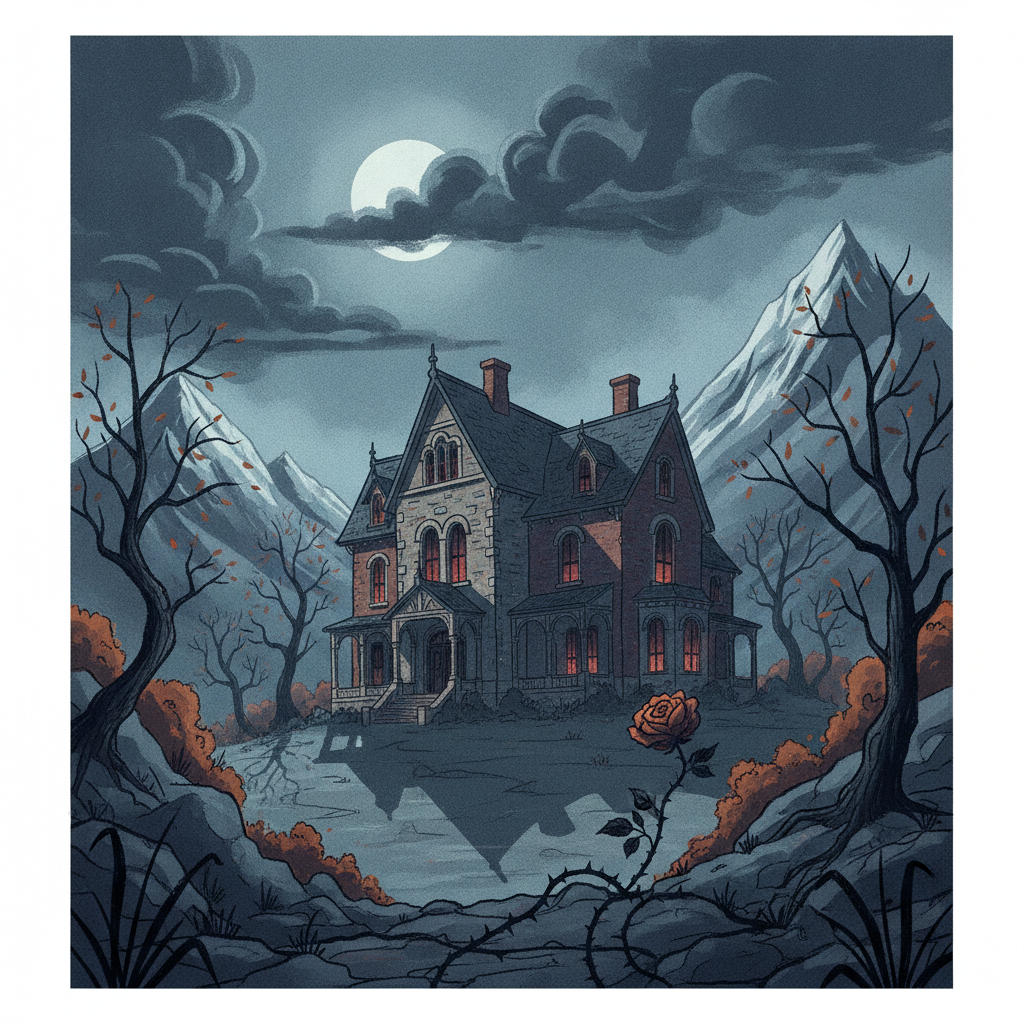
The rose-colored stone looms over Pueblo’s Grand Avenue like something transplanted from a Newport summer estate — three stories of turrets, gables, and Richardsonian Romanesque heft, thirty-seven rooms deep, built at a scale that still looks faintly absurd against the modest brick houses around it. This is Rosemount, the mansion John A. Thatcher built in 1893 for his family’s fortune, and which now operates as a house museum preserving one of the most intact Gilded Age interiors in the American West. It is also, by long local reputation, one of the most haunted buildings in southern Colorado.
Separating the two — the documented history and the decades of ghost stories layered on top of it — is the real work of understanding Rosemount. The facts alone are strange enough.
A Banking Fortune Carved in Rhyolite
John A. Thatcher was among the wealthiest men in Colorado in the late nineteenth century, a Pueblo banker whose business interests in finance, livestock, and regional development made him a central figure in the city’s rapid industrial growth. Rosemount was built for his family between 1891 and 1893, constructed from rose-hued rhyolite stone quarried locally — the source of the mansion’s name. At a reported cost well into six figures, an enormous sum for the era, the house was outfitted not with reproductions but with original furnishings, many purchased directly from the 1893 World’s Columbian Exposition in Chicago, the same fair that introduced the country to electric lighting on a grand scale and the moving sidewalk. Much of that furniture, along with the home’s original wallpaper, light fixtures, and woodwork, survives intact today — a rarity among Gilded Age mansions, most of which were stripped, sold off piecemeal, or demolished long before historic preservation became a civic priority.
Rosemount is listed on the National Register of Historic Places, recognized both for its architecture and for the unusual completeness of its interior. Walking through it is less like touring a museum than stepping directly into 1893, down to the servants’ call system and the carriage house out back.
The Thatcher Family and the Slow Fade of a Dynasty
Like many of Colorado’s banking and ranching dynasties, the Thatcher family’s story is one of boom-era ambition followed by a long, quieter decline. The house passed down through family hands for decades after John A. Thatcher’s death, but maintaining a thirty-seven-room mansion on a Gilded Age scale became increasingly untenable as the twentieth century wore on and Pueblo’s steel-and-rail economy shifted beneath it. By the 1960s, with the family no longer able to sustain the property, Rosemount faced the fate of so many grand American houses of its era: sale, subdivision, or the wrecking ball. Instead, a local preservation effort intervened, and the mansion opened to the public as a museum in 1968, with its contents preserved largely as the family left them rather than restaged for display.
That preservation effort is also how Rosemount came to house one of its strangest and most debated artifacts: an Egyptian mummy, part of a broader collection of curiosities — the McClelland Collection — assembled through a family member’s world travels and donated to the museum. The mummy has long been one of Rosemount’s most talked-about holdings, drawing both fascination and, in more recent years, ethical scrutiny common to museums worldwide that display human remains acquired during the colonial-era collecting boom of the late nineteenth and early twentieth centuries. It is, unquestionably, real — a documented part of the museum’s holdings, not a ghost-tour embellishment. What visitors make of sharing a Victorian mansion with a three-thousand-year-old human body is another matter entirely.
Where History Ends and Legend Begins
It’s here, at the intersection of a genuine mummy, a lavish dead banker’s house, and decades of candlelit evening tours, that Rosemount’s ghost stories took root. Colorado’s regional ghost-tour circuit and local lore have long claimed the mansion as haunted — footsteps on the grand staircase with no one on it, cold spots that move from room to room, a piano in the music room said to sound as though it’s being played when the house is empty, and whispered claims that the mummy itself is restless in its case. These stories circulate widely in Pueblo and across southern Colorado’s regional ghost-tour and Halloween-season coverage, the kind of local legend that gets repeated every October without a clear origin point or documented first sighting.
It’s worth being honest about what that means: these are reports of reputation, not verified incidents. There is no equivalent here to a formal case file or a named witness statement on public record, the way there might be for a declassified military sighting. What exists instead is the accumulated weight of a story a city has told itself for more than half a century — a mansion built on sudden wealth, filled with a dead family’s belongings, holding an actual human body in a glass case, sitting empty at night. Even without a single verified apparition, it’s not hard to understand why the legend persists.
That persistence fits into something larger happening across Colorado right now. Colorado Public Radio recently put out a call asking residents to share their own ghost stories, urban legends, and strange tales from around the state — a sign of just how much appetite there still is for this kind of regional folklore. Traveling attractions like Paranormal Cirque have been booking stops in Colorado Springs, paranormal investigation teams have been documenting old Denver buildings turned restaurants and bars, and even a supposedly haunted Denver mansion made headlines this year simply for going up for lease. Rosemount belongs to that same lineage of Colorado’s haunted real estate — old money, old architecture, and old stories that refuse to be fully laid to rest.
Visiting Rosemount Today
None of this is to say the mummy or the mansion’s gorgeous original interiors need a ghost story to justify a visit. Rosemount stands on its own as one of the best-preserved examples of Gilded Age domestic architecture in the Mountain West, a window into how dramatically — and briefly — Pueblo’s industrial wealth could be displayed. The haunted reputation is, in the end, an addition to the history rather than a replacement for it: a layer of folklore draped over real walls, real furniture, and a real family whose fortune outlasted their occupancy of the house by exactly one century before the public took over its care.
Whether anything unexplained actually walks Rosemount’s halls after the lights go out remains, like most Colorado ghost stories, a matter of who you ask and how late at night you’re asking it. What’s certain is that the house itself — the stone, the staircase, the mummy in its case — isn’t going anywhere, and neither, it seems, are the stories that have grown up around it.