
The Beaumont Hotel: Ouray's Haunted Victorian Grand Dame
Inside the Beaumont Hotel in Ouray, Colorado — a restored 1887 mining-era landmark with a persistent reputation for ghostly guests who never checked out.
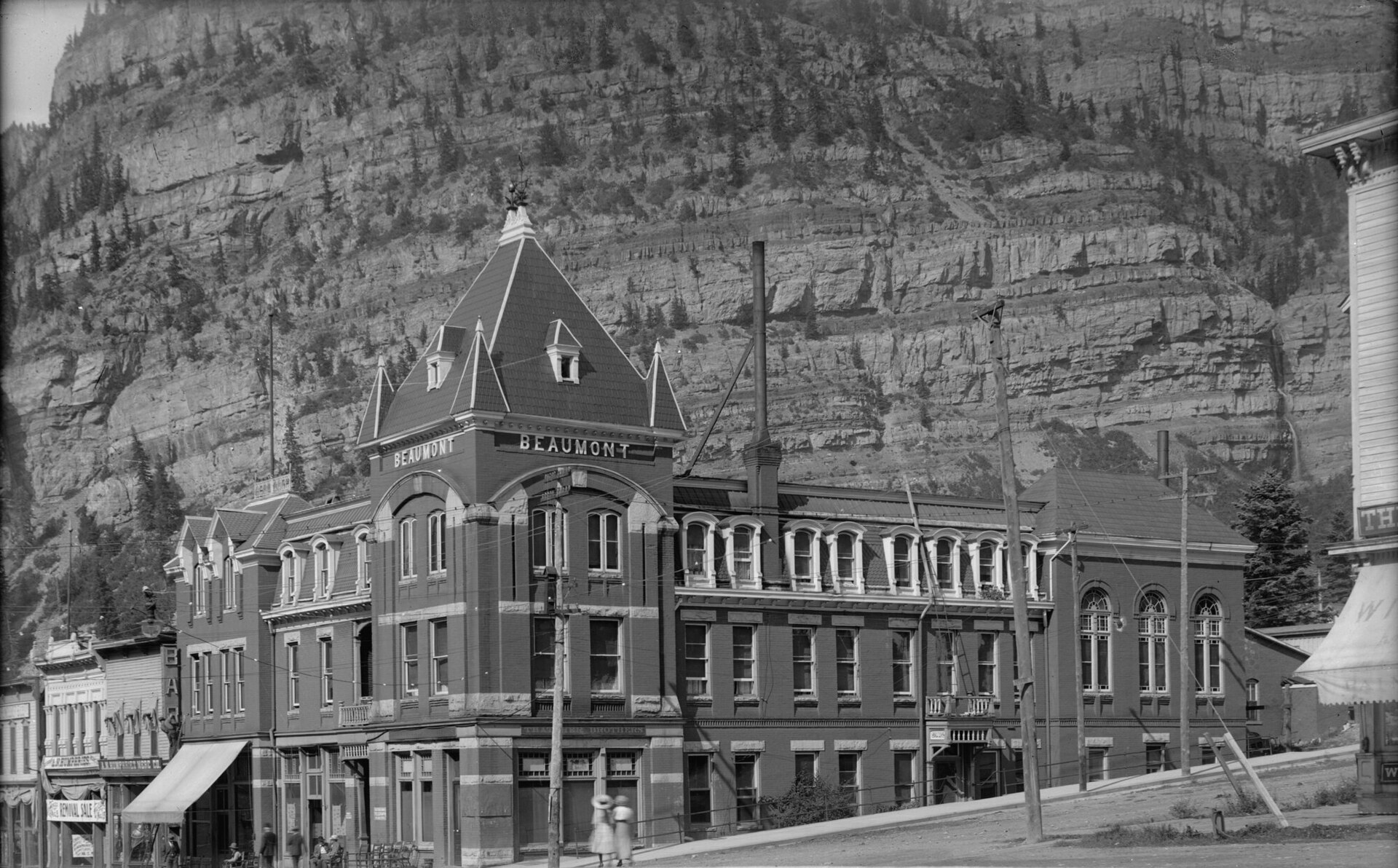
The San Juan Mountains have a way of swallowing sound. Drive into Ouray at dusk, when the cliffs close in on three sides and the light goes violet over the peaks, and you understand why nineteenth-century miners called this place the Switzerland of America — and why so many of them never quite seemed to leave it. At the center of that feeling sits the Beaumont Hotel, a red-brick Victorian landmark that has watched the town’s silver boom, its bust, its decades of decay, and its slow return to life. Along the way, it picked up a reputation that has outlasted every other chapter of its history: people who stay there often say they aren’t alone.
A Boomtown’s Grandest Address
The Beaumont was built in 1886 and opened its doors in 1887, at the height of Ouray’s silver rush, when the surrounding mountains were being hollowed out by mines with names like Camp Bird and the Revenue Tunnel. According to the hotel’s listing on the National Register of Historic Places, it was constructed to be the finest hotel between Denver and Salt Lake City — an audacious claim for a town tucked into a box canyon, but not an empty one. The building reportedly cost around $165,000 to construct, an enormous sum for the era, and it featured amenities that would have seemed almost absurd for a remote mining camp: one of the first elevators installed west of the Mississippi, gas lighting, and elegant Victorian architecture meant to signal to the world that Ouray’s fortunes were serious and permanent.
For a while, they were. The Beaumont became the social hub of the San Juans, the kind of place where mining executives, investors, and travelers of means stopped to do business and be seen. Local history and tourism accounts have long associated the hotel with prominent visitors passing through the region during Colorado’s mining-boom decades, though as with many grand hotels of the period, some of those connections rest more on local tradition than on hard documentation — a distinction worth keeping in mind as the Beaumont’s legend has grown over the past century.
Decline, Abandonment, and a Second Life
Silver’s collapse after the Panic of 1893, and the slower fade of Ouray’s mining economy in the decades that followed, hit the Beaumont hard. The hotel limped along through changing ownership and changing fortunes until it closed in 1964, and for roughly three decades afterward it sat largely vacant — boarded windows, peeling paint, a grand dame left to the dust. Colorado has no shortage of buildings from this era that simply vanished once mining money dried up. The Beaumont is one of the rare ones that didn’t.
Restoration efforts began in earnest in the 1990s, and the hotel reopened to guests in 2003 after extensive renovation work that preserved its Victorian bones — the pressed tin ceilings, the ornate woodwork, the bones of a building that had been built to impress — while updating it for modern travelers. Today it operates as a boutique hotel and is listed on the National Register of Historic Places, a recognized piece of Colorado’s mining heritage. It’s also, by local reputation, one of the most haunted buildings in the state.
The Ghosts Who Never Checked Out
Ask around Ouray long enough and you’ll hear the same broad strokes repeated in different forms: unexplained cold spots on the upper floors, footsteps in empty hallways, doors that won’t stay closed, and the sense — reported informally by guests and staff over the years — of being watched in rooms that are otherwise empty. Local lore frequently centers on a woman in old-fashioned dress seen or felt on the upper floors, sometimes described in regional ghost-story collections as a jilted bride or a grieving widow tied to the hotel’s mining-era heyday. These accounts circulate widely in Colorado tourism and local history writing, including roundups of the state’s haunted locations such as those published by Uncover Colorado, but it’s important to be clear about what that means: these are oral traditions and secondhand reports, not documented sightings with named, verifiable witnesses. No contemporaneous 1880s newspaper account ties a specific death or tragedy to the Beaumont that would explain the haunting in the way, say, Denver’s Molly Brown House or the Stanley Hotel in Estes Park have more detailed documented backstories.
What can be said honestly is this: the Beaumont’s reputation for strange activity is long-standing, consistent across decades of local storytelling, and embraced rather than hidden by a town that has built part of its identity on its mining-ghost-town past. Ouray leans into its history of hard luck and sudden fortune, and the Beaumont, as its most visible surviving monument to that boom era, has become a natural vessel for the stories visitors want to tell about it.
Part of a Larger Pattern
The Beaumont doesn’t haunt Colorado’s imagination alone. The state is thick with grand old hotels built on mining-boom money that later became synonymous with the paranormal — the Stanley Hotel’s influence on Stephen King’s The Shining being the most famous example, but far from the only one. Denver’s own ghost-hunting culture has stayed active in recent years: paranormal investigators have conducted on-camera explorations of sites like Ophelia’s Electric Soapbox and a downtown Denver restaurant that was once a mortuary, according to reporting from Denver7, CBS News, and 98.5 KYGO. A Colorado teacher has even built a reputation for approaching paranormal investigation with scientific rigor rather than pure folklore, as 9News reported in 2026. Taken together, it suggests something durable about Colorado’s relationship with its own haunted past: these aren’t stories told once and forgotten, but ones actively revisited, investigated, and in some cases subjected to real scrutiny.
That same spirit of scrutiny is worth applying to the Beaumont. The building’s history — the 1886-87 construction, the silver-boom ambition, the decades of abandonment, the careful restoration — is thoroughly documented and genuinely remarkable on its own terms. The haunting is something else: a layer of story laid over real history by generations of guests, staff, and townspeople, repeated often enough and consistently enough to have become part of what the hotel is.
Visiting the Beaumont Today
The Beaumont Hotel still operates as a working hotel in downtown Ouray, its red brick and white trim standing out against the canyon walls the way it must have in 1887, when it was the most ambitious building for a hundred miles in any direction. Guests come for the hot springs, the Jeep trails, the dramatic scenery that gave the town its nickname — and more than a few come hoping, or half-hoping, to feel something they can’t explain. Whether what waits in the Beaumont’s upper hallways is memory, suggestion, or something that genuinely never left, the hotel remains exactly what it was built to be: the grandest address in a town that has never stopped living alongside its own history.