
The Legend of Blucifer's Lair: Denver Airport Tunnels Revisited
Beneath DIA's demon horse, rumor says secret tunnels connect to a hidden underground world. We separate documented fact from urban myth.
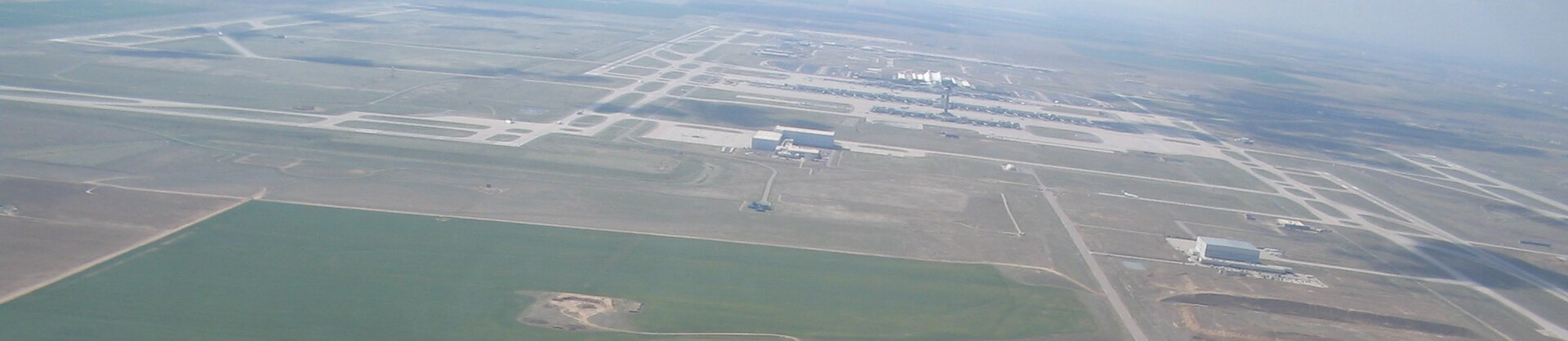
Drive south on Peña Boulevard toward Denver International Airport at dusk, and the first thing you’ll see rearing up against the plains sky is a 32-foot blue mustang with wild red eyes, forelegs pawing the air like something out of a fever dream. Locals call him Blucifer. Officially, he’s “Blue Mustang,” a sculpture by the late artist Luis Jiménez. Unofficially, he’s become the patron demon of one of America’s most persistent airport conspiracy theories — a legend that insists DIA isn’t just an airport, but the lid on something buried far below.
The full mythology is sprawling: Illuminati capstones, Masonic runways shaped like swastikas, murals depicting apocalyptic children’s crusades, and whispers of a vast underground city connected by secret tunnels. Most of that has been picked apart plenty of times. But there’s a piece of the story that rarely gets its due — because it isn’t myth at all. It’s a matter of public record, and it happens to be one of the most spectacular infrastructure failures in modern American engineering history. Understanding it is the key to understanding how DIA became a myth factory in the first place.
The Tunnels That Actually Exist
Strip away the saucer-eyed speculation, and here’s what’s true: there really are tunnels under Denver International Airport. They’re not secret, and they don’t lead to an underground city — they were built, in plain view of contractors, auditors, and eventually the national press, to house one of the most ambitious automated baggage-handling systems ever attempted.
When DIA was being designed in the late 1980s and early 1990s, planners envisioned a fully automated system that would route checked luggage through miles of underground track using a network of telecars — small, independently routed carts gliding on rails beneath the terminal and concourses, guided by barcode scanners and a web of computer controllers. The pitch was that bags could move faster and more efficiently than any human-operated system, cutting turnaround times and giving the new airport a futuristic edge.
Instead, it became one of the most publicly documented technology disasters of the decade. The system, built primarily by BAE Automated Systems, struggled for years with bags being misrouted, crushed, flung from carts, or simply lost in the maze of underground track. Telecars collided. Sensors misread barcodes. The software couldn’t keep pace with the physical complexity of the tunnel network. The failures were severe enough — and public enough — that they delayed the airport’s opening by well over a year, a delay widely reported to have cost the city of Denver over a billion dollars in bond interest, overruns, and lost revenue before the airport finally opened in February 1995, roughly sixteen months behind its original schedule.
Eventually, large portions of the automated system were scaled back or abandoned altogether in favor of conventional, human-assisted baggage handling. The tunnels, though, remained — empty of their original gleaming vision, but very much real, running beneath the terminal and out toward the concourses, a literal underground infrastructure built for a 21st-century idea that the 20th century wasn’t quite ready to deliver.
How an Engineering Failure Became a Myth
Here’s the thing about empty tunnels under a major airport: nature abhors a vacuum, and conspiracy theory abhors it even more.
By the time DIA opened, it already had unusual public art to contend with. Artist Leo Tanguma had been commissioned to paint a series of large murals for the terminal — works with titles like “In Peace and Harmony with Nature” and “The Children of the World Dream of Peace.” Tanguma has spoken publicly over the years about the murals’ intended message: a meditation on environmental destruction, war, and the hope for a peaceful future, rendered in the kind of stark, surreal imagery common to murals addressing those themes — gas-masked soldiers, weeping children, a girl holding a dead dove. Taken on its own, it’s political art in a familiar tradition. Taken alongside a mysterious decommissioned tunnel network running beneath the building, it became something else entirely in the eyes of online theorists: evidence.
Add in a dedication capstone from the New World Airport Commission — a real organization that, according to public reporting, was a group formed to help fund and promote the airport’s construction, its name an unfortunate coincidence for anyone primed to see “New World Order” lurking everywhere — and the pieces of a legend snapped together almost on their own. Runways that from above resemble a stylized swastika (an artifact, officials have said, of wind-pattern-optimized runway design, not intentional symbolism). A blue horse with demonic red eyes, erected in 2008, that reportedly fell on and killed its own sculptor, Luis Jiménez, during fabrication in 2006 — a tragic, well-documented accident that nonetheless reads like an omen once folded into the larger narrative.
None of these elements were secret. The murals are in a public terminal. The capstone is visible to any traveler who looks down. The baggage tunnels were covered in detail by major outlets at the time, including extensive contemporary reporting as the system’s failures became a national punchline. But urban legends rarely need secrecy to grow — they need ambiguity, scale, and a few unsettling coincidences stacked close enough together that the human brain, wired to find patterns, does the rest of the work for free.
Separating the Record from the Rumor
What we can say with confidence: DIA has real tunnels built for a real automated baggage system that really failed in spectacular, costly, well-documented fashion. The murals, the capstone, and the statue are real public art and architecture with real — if sometimes grim — histories behind their creation. What we cannot say, because no credible evidence supports it, is that any of this connects to a hidden underground base, a secret world government, or anything resembling the vast conspiracy that internet lore has constructed around it.
What makes DIA’s legend worth revisiting isn’t whether it’s “true” — it isn’t, by any evidentiary standard — but what it reveals about how modern myths are built. Give the public a genuine engineering mystery, pair it with ambiguous art and a little dark tragedy, and the resulting story will almost always travel farther and last longer than the mundane truth: that a very expensive robot baggage system broke down in the Colorado high plains, and nobody ever fully explained why it had to fail quite so badly before anyone pulled the plug.
The Myth Endures
Three decades on, Blucifer still rears over Peña Boulevard, murals still loom over security lines, and travelers still pause at the capstone to take a photo they’ll caption with a knowing wink. DIA leans into it now rather than fighting it — the airport’s own social media has had fun with the lore for years. Perhaps that’s the most honest ending to the story: not a secret city below Denver’s high plains, but a very public monument to how easily a true, strange, and costly failure of engineering can be remembered as something far darker than it ever was.